 Bắc Ninh


Vietnam explores RNA technology for cancer vaccines
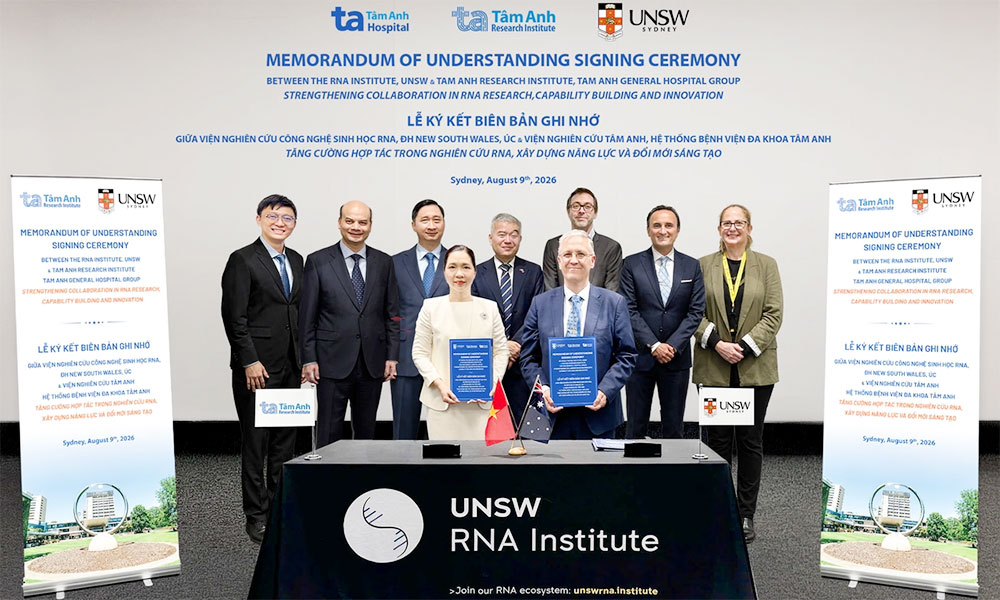
Tam Anh Research Institute and the RNA Institute at the University of New South Wales (UNSW), Australia, are collaborating on RNA-based biomedical research, including potential vaccines for lung cancer, colorectal cancer and influenza.
The two institutes recently signed a cooperation agreement in Sydney, witnessed by Vietnam's Consul General, during Party General Secretary and State President To Lam's state visit to Australia from August 9 to 12.
 |
|
Guests and leaders of the two organizations at the signing ceremony on August 9, 2026. |
The partnership focuses on two programs: developing an mRNA influenza vaccine and personalized cancer vaccines for patients with lung and colorectal cancer, which are major health concerns in Vietnam and the Asia-Pacific region.
Tam Anh said this is the first time a Vietnamese research institute has partnered with an institute specializing in RNA biomedical platforms at a top Australian university on the principle of joint investment, joint research and joint publication of products.
The two sides plan to conduct training and expert exchanges, establish research protocols, and develop capabilities in RNA design, synthesis, purification, quality control and packaging. They will then explore preclinical studies and clinical trials of RNA-based products in Vietnam.
Professor Pall Thordarson, director of the UNSW RNA Institute, said the partnership aims to strengthen Tam Anh's capabilities in RNA research, preclinical development, production, GMP (Good Manufacturing Practice) standards, and clinical trials.
He also said the value of the partnership lies not only in technology transfer, but in jointly generating data and solutions suited to the disease characteristics of both Vietnamese and Southeast Asian populations.
The number of patients and the biological characteristics of diseases in Vietnam could fill data gaps that currently exist in the international databases being used to develop RNA therapies.
These lines of research could create direct value for Vietnam while expanding both sides' RNA data and research capacity in the Asia-Pacific region.
The partnership opens an opportunity for Vietnamese institutions to progressively master RNA technology, the strategic platform underpinning many next-generation vaccines, biologics and therapies.
Through this, Tam Anh Research Institute hopes to participate more deeply in the value chain of one of the world's fastest-growing biotechnologies.
The partnership is intended to help Vietnamese researchers develop expertise across the RNA technology chain, from research and development to clinical applications and potential domestic manufacturing.
"Vietnam should not stop at being an endpoint of manufacturing; it is fully positioned to become a center of design and evaluation for diseases and population groups that the global research chain has not given adequate attention to," Professor Pall said.
Nguyen Thanh Tung, Vietnam's Consul General in Sydney, said, "Strengthening domestic research and technology capacity in emerging fields such as RNA not only matters for scientific development but also helps Vietnam improve its preparedness and its capacity to respond to future public health challenges."
Dr. Phuong Le Tri, executive director of Tam Anh Research Institute, said the partnership would give Vietnam access to a development model covering basic research, technology development, preclinical evaluation, clinical trials and potential domestic manufacturing.
RNA (ribonucleic acid) carries genetic information and helps cells produce proteins. RNA-based technologies include mRNA for vaccines and some therapies, siRNA for regulating disease-related genes, and guide RNA (gRNA) for gene-editing applications.
These technologies are being studied for applications in cancer, genetic and immune disorders, rare diseases, and other areas of biomedicine.
Professor Pall said Vietnam could become an important participant in RNA research in the Asia-Pacific region. He cited the country's experience with mRNA vaccine clinical trials and the World Health Organization's recognition of Vietnam's vaccine regulatory system at Maturity Level 3.
He also pointed to Tam Anh's research infrastructure, including 68 research sites connected to Tam Anh General Hospital Group and nearly 300 VNVC vaccination centers nationwide.
The institute has research collaborations with Stanford University and the University of Oxford and participates in clinical trials, including VISTA-1, a study of RBS2418, an oral immunotherapy for patients with late-stage colorectal cancer.
"We regard Tam Anh Research Institute as a leading candidate for building a partnership that will create a lasting and substantive impact on the development of RNA research and technology in the Asia-Pacific region," Professor Pall said.
The partnership is expected to expand research capacity in Vietnam's biomedical sector and support domestic expertise in RNA-based vaccines and therapies.
Vietnam and Australia established diplomatic relations in 1973 and upgraded ties to a Comprehensive Strategic Partnership in March 2024.
Two-way trade reached about $14 billion in 2025, making Australia Vietnam's seventh-largest trading partner and Vietnam Australia's 10th-largest.






Reader's comments (0)