 Bắc Ninh


120-meter-deep sinkhole explored in Phong Nha-Ke Bang National Park
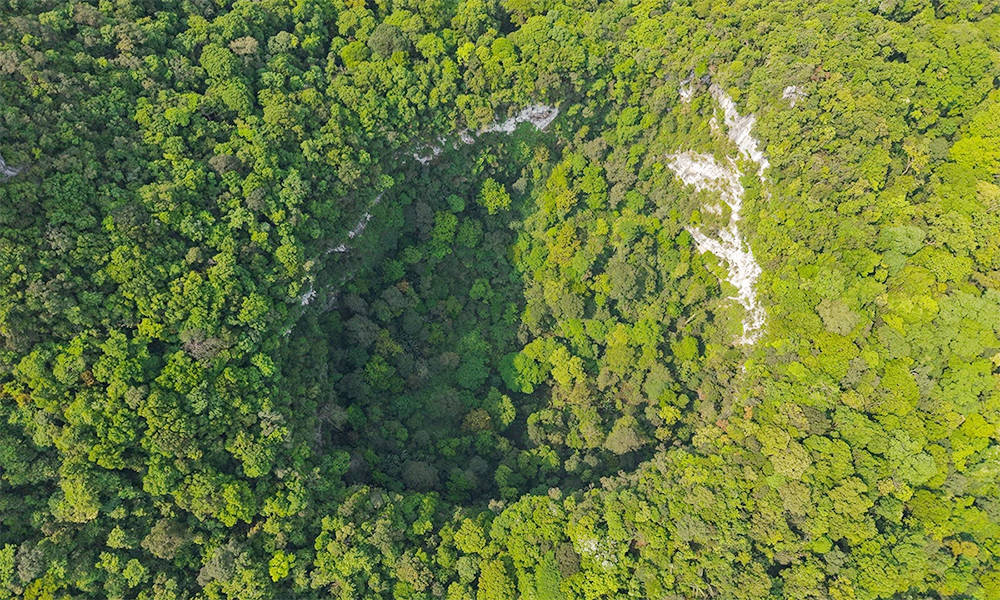
A sinkhole measuring 190 meters wide, 140 meters long, and 120 meters deep, and with a primeval forest at its bottom has been explored in the Phong Nha-Ke Bang National Park in central Vietnam.
Exploration company Jungle Boss, experts from the U.S. National Speleological Society (NSS) and the Phong Nha-Ke Bang National Park announced the findings of a survey in the Cha Noi-Khe Gat area of Quang Tri Province on October 22.
 |
|
A 120-meter-deep sinkhole in Phong Nha-Ke Bang National Park seen from above. Photo by Jungle Boss |
The sinkhole has an oval-shaped opening that widens toward the bottom, which is covered in dense vegetation.
Kevin Ditamore, an NSS member, first noticed an unusual dark patch in satellite images on Google Earth. He and other experts then conducted three reconnaissance missions with Jungle Boss using drones, which confirmed the presence of the sinkhole.
In April 2025, a 10-member team, including two forest rangers, attempted to reach the site but turned back at the rim because of difficult terrain and insufficient supplies.
A 24-member expedition conducted the survey a few months later in July.
The team, comprising NSS experts, Jungle Boss technical staff, and local forest rangers, trekked more than 20 kilometers through thick forest and across sharp limestone formations before installing safety ropes to descend into the sinkhole.
At the bottom, researchers examined its dimensions, geological structure, and ecosystem. They found collapsed limestone blocks, cliffs bearing traces of stalactites, dense vegetation, shells, and the bones and skulls of monkeys. Monkey calls also indicated that the site remains a wildlife habitat.
The team searched for an entrance to an underground cave system but found no large openings. Several cracks and cavities in the limestone may serve as drainage routes. One fissure measured about five meters high and extended 12-15 meters into the rock, but researchers detected no airflow.
Ditamore said water may drain through multiple small crevices rather than a single cave entrance. Without a sufficiently large opening or detectable underground airflow, the team could not confirm whether the sinkhole connects to an underground cave system.
Nguyen Van Uy, Deputy Director of Jungle Boss, said it was one of the largest sinkholes he had encountered during more than 20 years of exploring the forests of Phong Nha-Ke Bang.
Jungle Boss has submitted its report and survey data to the national park's management board and proposed further research into the site's geology and ecosystem and search for additional access routes to the Cha Noi–Khe Gat area.
Five large sinkholes have been documented in the Phong Nha-Ke Bang area, including one known as Kong. The new one is smaller and shallower than Kong.
Sinkholes of this type typically form when water gradually erodes limestone, creating underground cavities. When the rock above loses structural support, it can collapse, leaving a large depression or opening.
Phong Nha-Ke Bang National Park was designated a UNESCO world heritage site in 2003 and expanded in 2015. The area is known for its extensive limestone cave system, including the world's largest cave Son Doong.








Reader's comments (0)