 Bắc Ninh


Education ministry reveals plan to develop elite universities
A group of 25-30 key institutions will be responsible for training skilled workers that will provide leadership in their respective regions and sectors. The remaining institutions will focus on practical, career-oriented training.
A plan to stratify the higher education network and develop universities with unique strengths was revealed by the Ministry of Education and Training on August 10.
 |
|
Illustrative image. |
Education officials and university representatives gathered at a conference in Hanoi to discuss the plan.
It is one of several steps being taken to actualise goals set in the Political Bureau’s Resolution 71 on creating breakthroughs in education and training, as well as in the Government's the Higher Education Development Strategy and the master plan for building a higher education institution network.
Speaking at the event, Deputy Minister of Education and Training Le Quan said that quality must become a keyword and an inherent value in Vietnam’s higher education system.
“Quality should not be defined solely by each institution, but must align with standards that meet the development needs of the country and the world,” he said.
While Vietnam has a high proportion of students graduating with honours, there are still graduates who remain unemployed, or work in fields unrelated to their majors, preventing them from fully using their abilities.
To fix this, higher education needs to shift from degree-based training and recruitment to an assessment of competence, focusing on what students can actually do after graduation, Quan said.
On the other hand, the system will also be stratified to meet different development needs, he added.
Some higher education institutions will be given the opportunity to focus on boosting their unique strengths.
The education ministry will develop a set of criteria to screen and select these institutions to develop into elite or excellent universities across different disciplinary groups, according to Quan.
Selected institutions will be required to clearly define their admissions and graduation standards, training processes and conditions for ensuring student quality. They may also register and select their areas of strength for development.
The criteria will not be rigid and applied to all schools, Quan said. Instead, the country’s needs will be identified in a stage-based roadmap for the 2026-30 period, from which each institution can develop their specific strengths accordingly.
A key requirement of this strategy is that institutions concentrate resources on strategic areas rather than spreading them too thinly, Quan noted.
“Universities need to take on challenging tasks and reallocate resources to establish their excellence and key areas of specialisation,” he said.
The stratification of the higher education network has also been studied by the ministry’s Department of Higher Education, said department director Nguyen Tien Thao.
According to the department’s strategy for higher education development through 2035 and to 2045, in the next decade, Vietnam aims to establish a group of three to five elite universities that will focus on cutting-edge research, international competitiveness and core innovation.
A group of 25-30 key institutions will be responsible for training skilled workers that will provide leadership in their respective regions and sectors.
The remaining institutions will focus on practical, career-oriented training.
“The stratification is designed to be dynamic and competitive, involving periodic assessments linked to each institution's mission, objectives, key performance indicators, resources and outputs,” said Thao.
“The guiding principle is that institutions will be allowed greater autonomy, but that will be accompanied by greater accountability.”
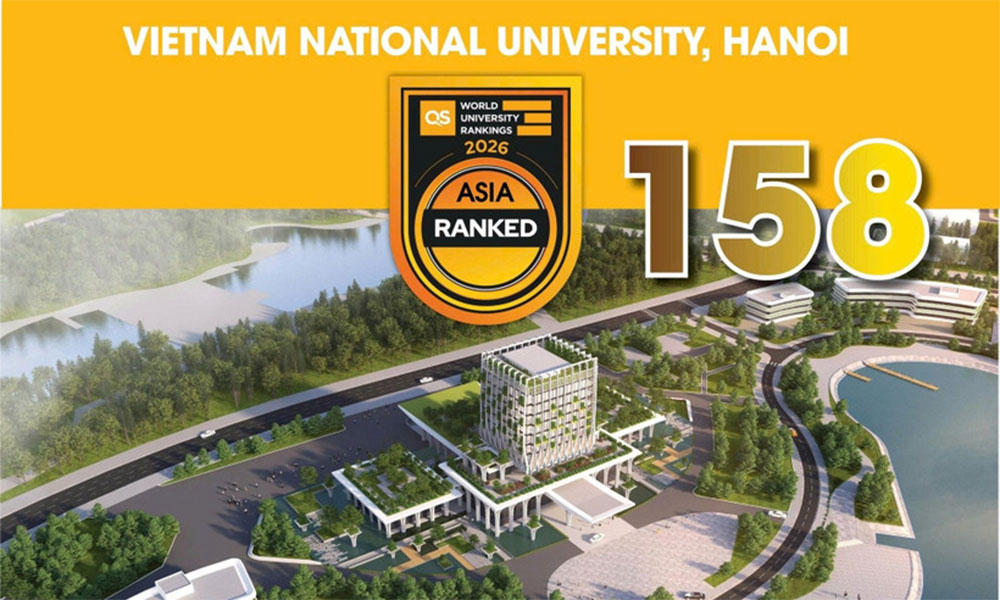
According to vice President of Vietnam National University Hanoi Dao Thanh Truong, Prime Minister Le Minh Hung has approved the institution for development into an elite research university by 2030. Goals set include 80% of its academic staff holding doctoral degrees and research in specific fields, such as artificial intelligence and semiconductor development, ranked among the world's top 100.
“Becoming an elite university requires a qualitative transformation,” he said. “We will have to shift from fragmented operations to integrating systemic strength, from scaling up to prioritising quality and talent development, and from merely generating academic results to creating social impact.”
To reach these overall goals, VNU proposed that the Government and education ministry allocate resources based on specific tasks and requirements, while simultaneously establishing systems to identify, nurture and enable institutions to collaborate and leverage their strengths.








Reader's comments (0)