 Bắc Ninh


Population bill supports women who give birth twice
The Ministry of Health is drafting the law, which encourages couples in localities with low birth rates to have two children.
The bill proposes that such localities give a one-time monetary support package to women who give birth to a second child.
 |
|
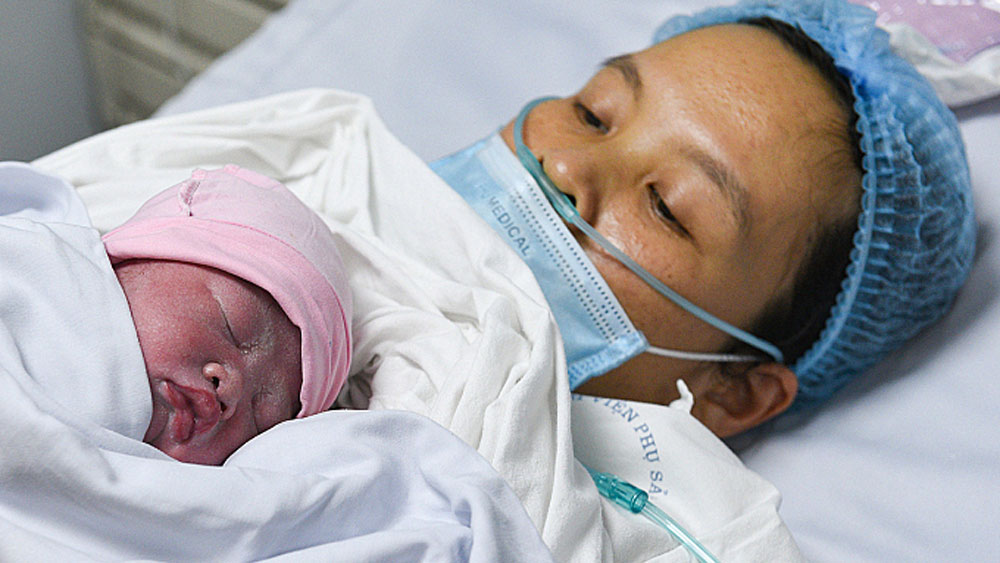
A mother holds her newborn baby at the National Hospital of Obstetrics and Gynecology in Hanoi. |
It also suggests waiving or reducing tuition fees for children in preschools and elementary schools, especially those in industrial parks and export processing zones.
Provinces and cities with low fertility rates will be required to review and abolish policies that encourage low birth rates, and instead encourage and create favorable conditions for couples to have two children, according to the draft law.
Vietnam's fertility rate has dropped sharply over the last two decades, leading to the risk of labor shortages.
The average number of children a woman of reproductive age had in 2001 was 2.28, but the ratio had decreased to 2.1 by 2021.
According to the latest Population and Housing Census, fertility rates in most socio-economic regions have decreased, especially the southeast region and the Mekong Delta.
Currently, each woman of childbearing age in the southeast region, including Ho Chi Minh City, Dong Nai and Binh Duong, only gives birth to 1.56 children. In the Mekong Delta, the figure is 1.8 children.
Women in HCMC currently have the lowest fertility rate in the country - 1.39 children per woman.
"If the fertility rate is below 1.3 children per woman, it is almost impossible for the locality to recover to replacement level fertility," said Mai Trung Son, deputy head of the Department of Population Size and Family Planning under the General Office for Population and Family Planning of Vietnam
Replacement level fertility is the level of fertility at which a population replaces itself equally from one generation to the next. In developed countries, replacement-level fertility can be taken as requiring an average of 2.1 children per woman.
"Low-fertility localities account for a population of nearly 38 million, which is almost 40% of the country's population. That means a huge impact on sustainable development," said Deputy Minister of Health Nguyen Thi Lien Huong.





Source: VnExpress








Reader's comments (0)