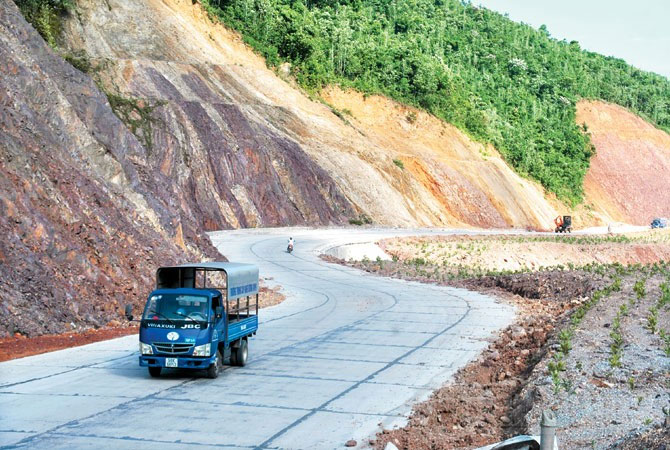
The first time going along the “spiritual road” – road 293, I was lucky to travel with Hoang The Hung, Deputy Director of Bac Giang province’s management board for transport investment projects, who is one of the few people having strong attachment to this road. Hung has travelled on this road for countless times during the past more than five years since the construction began. He not only travelled on the road by car but also left his footprints on every metre of the road. He has become familiar with roadside households and remembers every number relating to this project.
Road 293 is more than 92km long in total. It starts in Bac Giang city and ends at Thanh Son town of Son Dong district and includes three feeder roads. Hung joked that maybe this road should be applied for the record as the longest concrete road in Vietnam.
He said the initial estimated cost for this project was more than 2.8 trillion VND (123.2 million USD), and about 1.9 trillion VND (83.6 million USD) has been disbursed.
I was startled at the figures, as just two-thirds of the funding had been disbursed, and the remaining workload was not small at all.
“No, it’s because the road was built in an economical manner,” Hung said. Despite the estimate, only another 200-300 billion VND remains to be disbursed, which meant the project cost just around 2.2 trillion VND (96.8 million USD).
I breathed a sigh of relief. So the sum of saved money was considerable.
|
| But Pass on the Phat Son Mountain. |
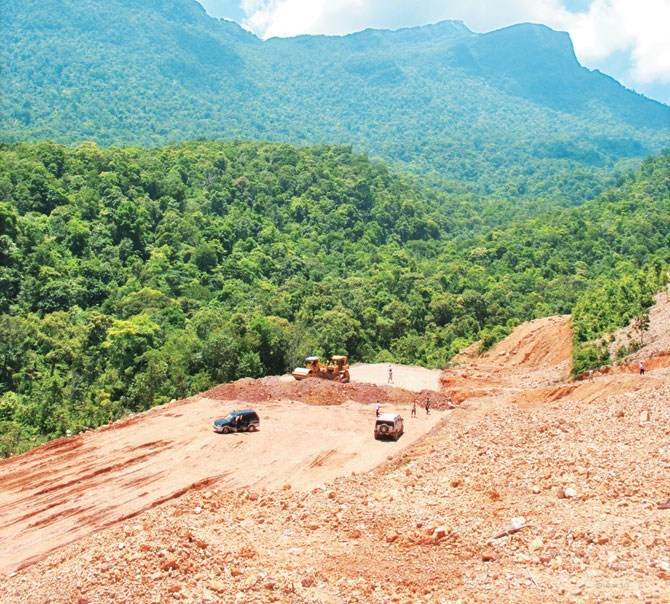
After passing Mo Spring in Luc Nam district, our car arrived at the temporary office of the construction company. A sturdy man with dark complexion came to welcome us. He was Pham Xuan Hoan, in charge of construction equipment for the Road 293 project. He told us that only six more kilometres needed to be paved with concrete. Although the construction had almost completed, it was still facing many difficulties. The two biggest problems were the weather and ground clearance. Therefore, the company had to mobilize all machines and workers to work around the clock whenever the weather is good. Besides, more than 20 households in Tuan Mau commune of Son Dong hadn’t agreed on the site clearance compensation, which was also a problem for the constructor.
Listening to Hoan, Hung said relevant agencies and local authorities decided that if any household did not leave, measures would be taken to move them to ensure the project go on as schedule.
Hoan said in that case, the entire road 293 project would finish in October.
Bidding farewell to Hoan, our car continued along Provincial Road 293. After driving for a while, Hung said we already arrived in the foot of But Pass on Phat Son Mountain, which is on the border line between Luc Nam and Son Dong districts. A temple named Trinh will be built there as part of a system of temples and pagodas in the Western Yen Tu cultural and spiritual complex. We went for a stroll from the foot of But Pass. The landscape there was so beautiful that we didn’t want to leave.
Although provincial road 293 is called a “spiritual road”, its “spiritual” features lies in the three feeder roads. The first feeder road leads to Vinh Nghiem Pagoda and Truc Lam Phuong Hoang Zen Monastery. Vinh Nghiem Pagoda is now popular among visitors since it is keeping a set of woodblocks that was recognised as a world heritage. Truc Lam Phuong Hoang Zen Monastery, which is near the centre of Yen Dung district, is the place where the biggest Buddhist structures in Vietnam are being built.
The second feeder road connects with Dong Trieu town (Quang Ninh province), which is home to Ngoa Van Pagoda situated on Bao Dai Mountain in Tay Son hamlet of Binh Khe commune. Ngoa Van Pagoda is the most important relic in the special national relic site of Tran Dynasty in Dong Trieu. It was where King-Monk Tran Nhan Tong attained Nirvana and became a Buddha. It is considered a “holy land” of the Truc Lam Buddhism sect, as well as of Vietnam Buddhism in general.
The third feeder road leads to the Western Yen Tu cultural and spiritual complex that covers 13.8ha of land in Tuan Mau commune of Son Dong district. The complex comprises four separate clusters of pagodas, namely Trinh Pagoda, Ha Pagoda (also called Phat Quang Pagoda), Trung Pagoda, and Thuong Pagoda (all called Kim Quy Pagoda). The pagodas, located on different heights, are linked with Dong (Bronze) Pagoda and the statue of King-Monk Tran Nhan Tong on Mount Yen Tu in Quang Ninh province.
Though the construction of the “spiritual road” just nears completion, it has brought about joy to many people. Nguyen Ba Hoang, who works at the 45 Coal Co. Ltd (Dong Ri hamlet, Son Dong district) and has his hometown in Viet Yen district, told me, “In the past, I returned home once a month. Now I go home every week because Road 293 is smooth now.” Meanwhile, Huyen, a grocer in Thanh Son town, is also happy since it is now much easier for her to go to the city to buy goods for her shop.
Hoang The Hung said he travels on this road almost every day and realises that the roadside landscape has changed dramatically over time. Trading activities have developed strongly. It is now convenient for local people to sell their agricultural products while more houses have been built. I agreed with Hung. Anyone who travelled to Luc Nam ferry terminal, Mo Spring or But Pass in the past will surely be amazed at miraculous changes in the western area of Yen Tu Mountain.
|
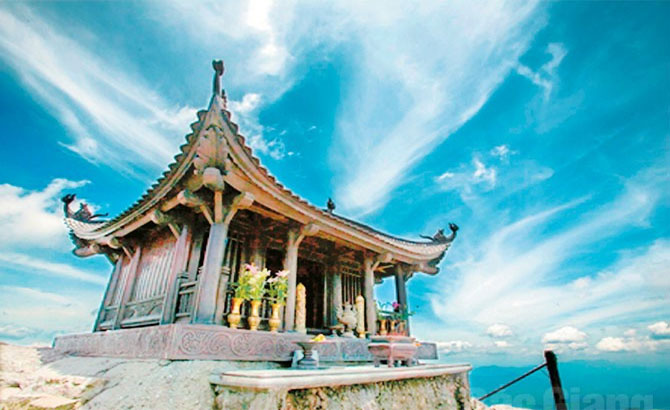
| Dong pagoda on Yen Tu Mountain. |
Waking up Western Yen Tu’s potential
Yen Tu Mountain is located in Dong Trieu – a bow-shaped range of mountains embracing the entire northeast of Vietnam. Most of the eastern side of this range belongs to Quang Ninh province while the western one is in the districts of Yen Dung, Luc Nam, Luc Ngan and Son Dong of Bac Giang province. While Yen Tu is the place where King-Monk Tran Nhan Tong practiced Buddhism and his sarira is kept, Western Yen Tu is where he popularised the Buddha’s teachings. At present, it takes only more than one hour by car from Bac Giang City to the Western Yen Tu cultural and spiritual complex.
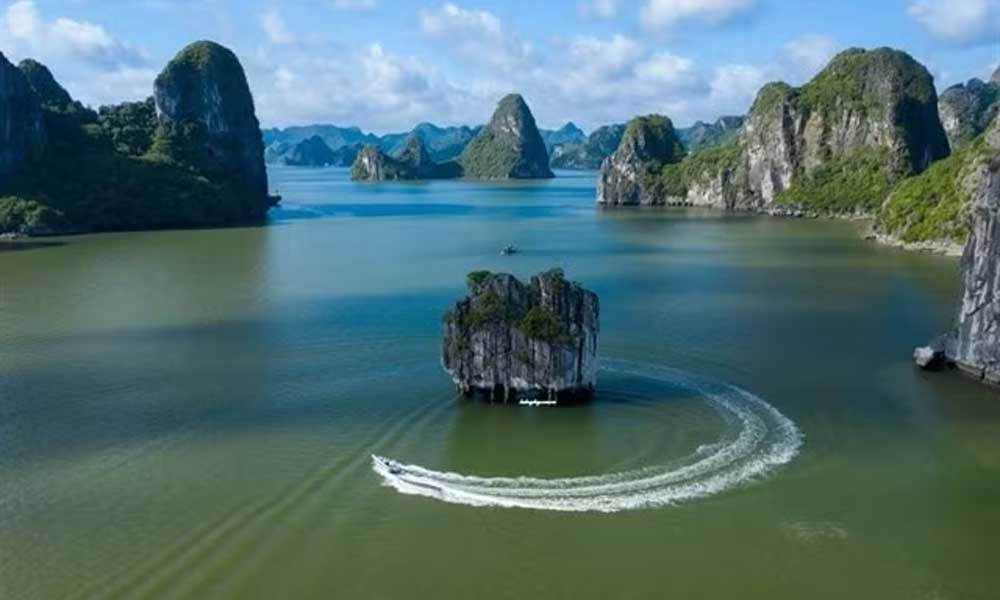
I was standing on the ground of Ha Pagoda in the Dong Thong area, the Western Yen Tu cultural and spiritual complex. It was windy here as if one could touch clouds and Dong Pagoda. There are no places the clouds and the sky are as beautiful as those in Yen Tu, and there are no forests as green as those in Yen Tu. The clouds shape like dragons or phoenix, they hide between mountains and even merge with dark green forests. Several hundreds of steps more and one can reach Dong Pagoda. From there, looking towards the sunrise direction, one can see an immense blue Ha Long Bay. Lying in the west is our hometown – Bac Giang, a land of vast orchards.
|
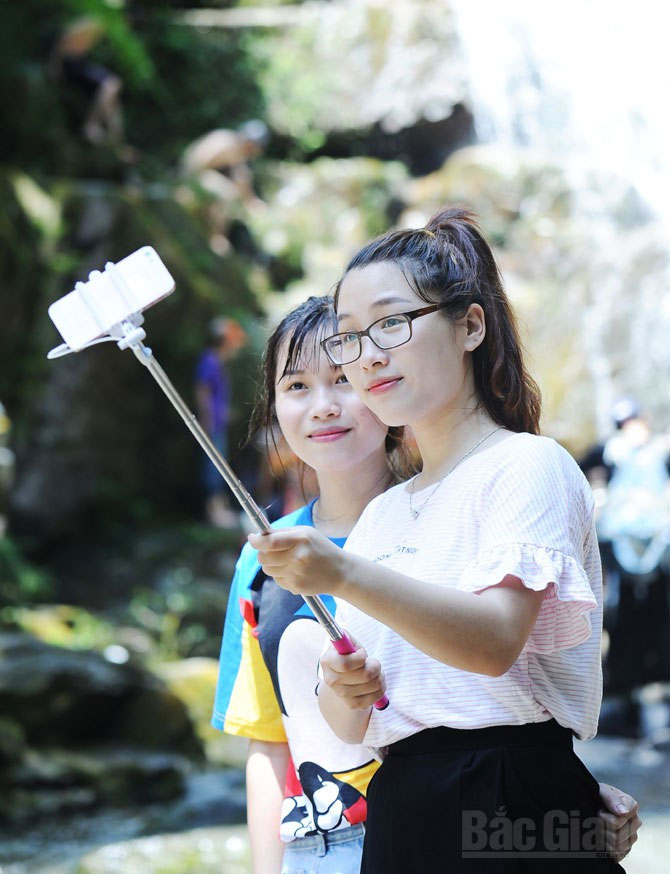
| Tourisms discovery the beauty of Ba Tia warterfall. Photo: Trieu Van |
I joined the busy atmosphere at the construction site of Ha Pagoda. The ground of the pagoda has been built, and workers now only have to wait for timber carried from lowland areas to continue their work. The construction is set to finish in the beginning of the new year 2017. I learnt that Ha Pagoda will be a highlight in the eastern Yen Tu spiritual cultural complex. It will house 108 towers where 108 bells weighing 108 tonnes in total will be hung. This pagoda will also be the venue of the Western Yen Tu Festival in early 2018.
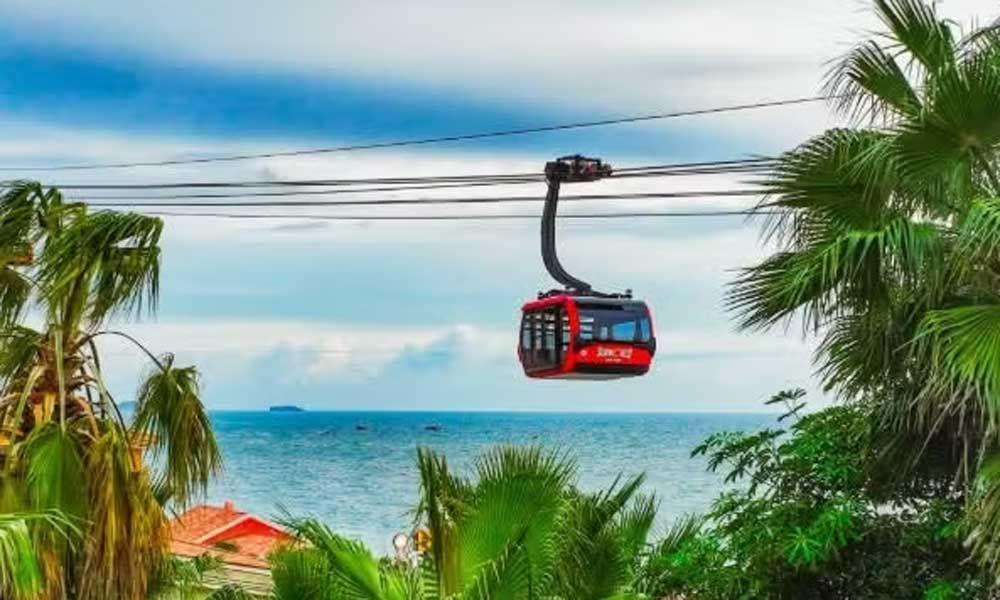
Ha Pagoda is built on nearly 5ha of land at a cost of about 250 billion VND (11 million USD), funded by private sources. According to the construction management board of the Western Yen Tu spiritual cultural complex, the pagoda has been built very quickly thanks to provincial officials’ attention. The provincial People’s Committee even held a meeting at the construction site to timely tackle difficulties. Aside from Ha Pagoda, preparations are also being made for the building of other items in the relic complex such as Thuong Pagoda, Trinh Pagoda, Trung Pagoda and technical infrastructure facilities such as electricity and water supply stations and a cable car system.
Standing in the Western Yen Tu cultural and spiritual complex today, as a member of the province’s steering board for tourism development in the 2016-2020 period, I became better aware of the importance of this relic site in the strategy for sustainable tourism development, which aims to earn tourism a bigger role in the local economy and create a driving force for socio-economic development. The three typical tourism products of Bac Giang: cultural-spiritual tourism, historical-cultural tourism, and ecological-leisure tourism will be promoted thanks to this complex. The works there will revitalise a cultural space and create a network of temples, pagodas, historical relics and landscapes, giving visitors an insight into the land of Bac Giang. This system will also help to preserve, restore and uphold the values of the heritage and landscapes in the Western Yen Tu area in the province in connection with the Yen Tu relic site (Eastern Yen Tu) in Quang Ninh province. With the complex, the old pilgrimage road will be restored, allowing visitors to go to the Truc Lam Zen Buddhism relic in Quang Ninh from Bac Giang.
Back to the “spiritual road”, Hoang The Hung said his unit will recommend the provincial authorities to choose plant species to be grown along some 20km of Road 293, starting from Bac Giang city. He named such species as sao den (Hopea odorata), lat hoa (Chukrasia tabularis), bang lang (Lagerstroemia speciosa), phuong vi (Delonix regia), hoa giay (Bougainvillea) and hoa dao (Amygdalus persica), which would be planted in three rows, and each species should be planted on separate stretches. I liked this idea very much.
So in the near future, King-Monk Tran Nhan Tong’s path of popularising Buddha’s teachings will become a “spiritual road” which will also be a “flower” and “tourism” road, attracting visitors to the beautiful and peaceful land of Bac Giang, as well as Truc Lam Yen Tu – the birthplace of the Truc Lam Buddhism sect./.
Tran Duc
 Bắc Ninh



Reader's comments (0)