 Bắc Ninh


Vietnam accelerates 5G rollout, paving the way for 6G development
Vietnam’s approach of deploying 5G rapidly and extensively reflects a consistent development philosophy aligned with international experience: infrastructure must come first.
Vietnam’s telecommunications carriers are racing to expand the 5G coverage, commercialise services effectively, and lay the groundwork for 6G, a roadmap seen as essential to sustaining the country’s digital transformation.
 |
|
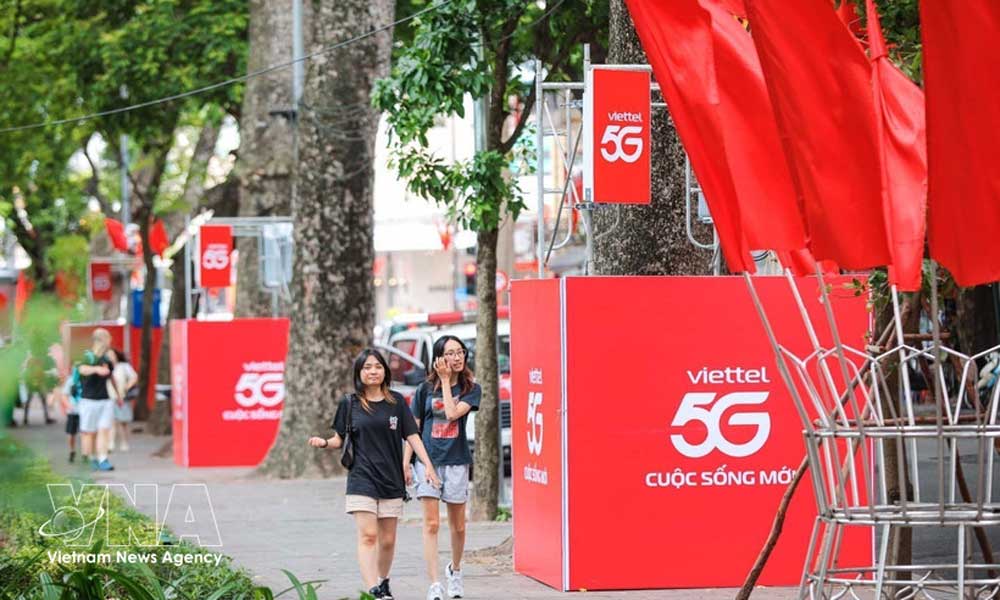
5G base stations are installed around Hoan Kiem Lake in Hanoi on the occasion of National Day (September 2) in 2025. |
According to the Vietnam Telecommunications Authority (VNTA) under the Ministry of Science and Technology, after more than a year of 5G deployment, Vietnam had installed nearly 40,000 base transceiver stations as of February 2026, covering about 90% of the population and serving close to 23 million subscribers.
Viettel has completed the installation of 23,500 5G stations in 2025 alone, bringing its total to over 30,000. The network now achieves 90% outdoor coverage and 70% indoor coverage nationwide, from urban centres to rural areas. The operator ranked among the world’s top 15 in terms of 5G infrastructure scale last year.
Viettel is also the only in Vietnam to have fully deployed a standalone 5G (5G SA) network, capable of delivering speeds of up to 10 Gbps. In real-world conditions, 5G speeds are typically 15–20 times faster than 4G.
Le Quang Hieu, Deputy General Director of Viettel Networks, said the group plans to add about 20,000 more stations in 2026, aiming to extend the 5G coverage to 98% of the population.
Meanwhile, VNPT plans to expand its 5G network using the C-band while rolling out services on the newly licensed 700 MHz spectrum by mid-2026.
Its network is expected to comprise around 16,000 stations, covering 50–60% of the population, with a focus on city centres, highways, industrial zones, seaports and airports.
“With speeds 10–15 times higher than 4G, 5G enables enterprises to automate production, develop telemedicine services and build smart cities,” a VNPT representative said.
MobiFone is prioritising 5G deployment in industrial parks, urban areas and major cities in 2026. Its 5G services are about 10 times faster than 4G, with latency reduced to between 1 and 30 milliseconds.
Nguyen Anh Cuong, VNTA Deputy Director, noted that achieving 90% population coverage within 12 months places Vietnam among the fastest 5G adopters globally.
This progress not only demonstrates technical capability but also helps create a more uniform digital infrastructure, narrowing the development gap between regions and between urban and rural areas.
Vietnam’s approach of deploying 5G rapidly and extensively reflects a consistent development philosophy aligned with international experience: infrastructure must come first. As the saying goes, railways must be built before trains can run, he noted.
Experts say that beyond deployment, effective utilisation of 5G is key to unlocking its full economic potential. Rita Mokbel, President of Ericsson Vietnam, said the country’s ambition to build 100 smart cities by 2040 is creating momentum for intensive and extensive digitalisation.
5G technology enables private networks for enterprises across sectors such as logistics, manufacturing and services.
To fully develop the digital economy, Vietnam needs to invest simultaneously in three pillars: upgrading network infrastructure, expanding fibre-optic coverage and accelerating 5G rollout.
These elements are closely interconnected and mutually reinforcing, forming a robust digital ecosystem.
A multi-pronged strategy with clear priorities will be crucial for Vietnam to achieve its digital economy targets by 2030.
In terms of applications, Mokbel noted, 5G can enhance quality and productivity in manufacturing, transform health care by enabling remote patient care, and improve efficiency in seaports by optimising the use of berths, cranes and vehicles while reducing environmental impact.
It can also support critical services such as emergency response, firefighting and drone operations.
As 5G expands, Vietnam is also preparing for the transition to 6G. At MWC Barcelona 2026, a global 6G alliance bringing together major technology and telecoms firms such as Google, Meta, Microsoft, Samsung, Siemens and SK Telecom was established, with Vietnamese representatives including FPT, Viettel and VNG.
The alliance aims to develop a comprehensive 6G ecosystem spanning devices, networks and cloud infrastructure, accelerate standardisation, conduct early system validation, and demonstrate pre-commercial technologies by 2028.
It also seeks to establish industry-wide readiness benchmarks and enable interoperable global 6G systems by 2029.
Truong Gia Binh, Chairman of FPT, said that as artificial intelligence, advanced computing, quantum technologies and large language models converge, 6G is emerging as a central intelligence layer integrating connectivity, sensing and high-performance computing into an AI-native platform.
He added that participation in the alliance will help Vietnamese firms transform advanced technologies into practical solutions across sectors, while strengthening capabilities in strategic areas such as intelligent transport, autonomous systems, smart manufacturing and advanced digital engineering.
Viettel Chairman and CEO Tao Duc Thang said the group is expanding cooperation with Qualcomm in 6G research and development, focusing on core technologies and smart device ecosystems to help build global digital infrastructure.
It plans to begin commercialising 5G-Advanced (5.5G) from 2027, followed by pre-commercial 6G trials in 2028, with the goal of launching commercial 6G services by 2029.
VNG Chairman Le Hong Minh highlighted that future AI will be closely tied to connectivity, with 6G serving as the backbone for AI agents delivering services to hundreds of millions of users.
VNPT has likewise prioritised 6G research, focusing on core technologies such as AI, big data and cloud computing, aiming to position Vietnam among the region’s leading digital economies.
With proactive investment and early engagement in 6G, Vietnamese enterprises are steadily moving closer to joining the ranks of global technology pioneers, a step seen as crucial amid an increasingly complex and rapidly evolving digital landscape.




Reader's comments (0)