 Bắc Ninh


Vietnam's hottest jobs in 2026: AI, sales and semiconductor surge
Vietnam's job market is shifting in 2026, with sales professionals and AI talent at the front of the hiring race.
After several years of restructuring, businesses are regaining stability and shifting focus back to two core priorities: boosting revenue and strengthening production. At the same time, companies are accelerating digital transformation and investing in new technologies, particularly artificial intelligence.
 |
|
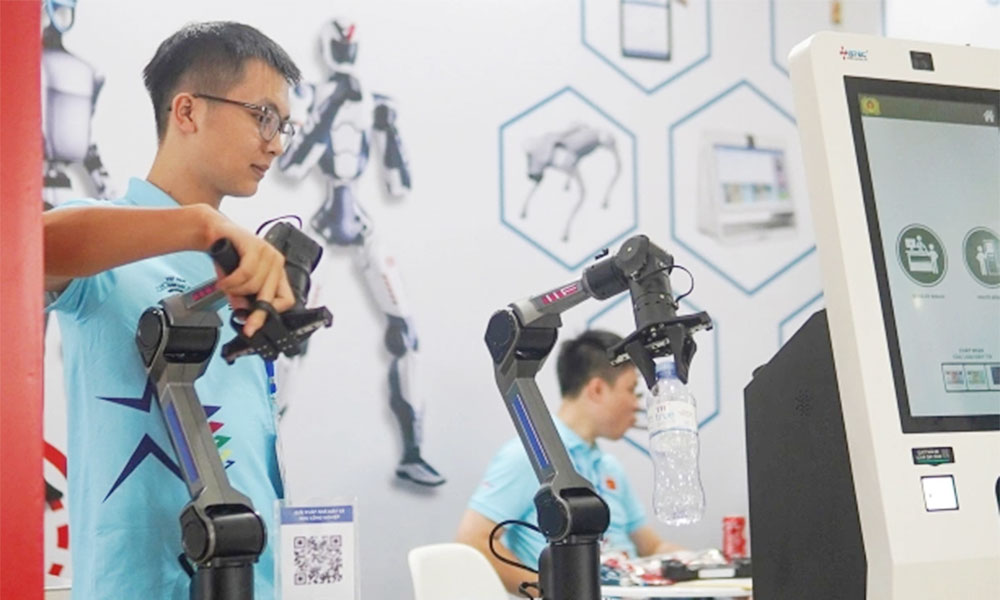
Technology products at Vietnam Innovation Exhibition, October 2025. |
Recent employment surveys released ahead of Tet show recruitment demand recovering across multiple sectors, with clear patterns emerging about who companies want most, and who may face tougher competition.
According to Navigos, sales accounts for 46% of recruitment demand this year, followed by IT-software at 13%. A similar survey by TopCV places business-sales at 48%, IT-software at 9%, communications-advertising at 8%, and customer service at 4%.
In sales, companies are overwhelmingly targeting professionals with one to five years of experience. More than 67% of employers say this group forms the operational backbone of their businesses, ready to generate revenue immediately without extensive retraining.
Recent graduates remain in demand, but to a lesser extent. About 31% of companies plan to hire fresh talent, reflecting efforts to build long-term workforce pipelines.
Meanwhile, around 20% are recruiting team leaders and mid-level managers. Businesses appear to be balancing short-term performance with long-term talent development.
In IT, the most sought-after roles include web developers (45%), back-end developers (37%) and AI engineers (30%).
Companies are not just expanding teams, but also upgrading them. Many are prioritizing candidates with deep expertise in AI, semiconductor technology and microchip-related engineering. Employers increasingly favor experienced professionals with strong systems thinking over entry-level applicants.
But competition is intense. More than half of companies report difficulty finding highly skilled candidates. Around 50% worry about losing talent to major tech firms, while 34% say the overall supply of qualified applicants remains limited. The result is a tightening market at the high-skill end.
Beyond technology and sales, healthcare-related professions are also seeing growing demand.
As Vietnam expands its healthcare system and awareness of mental well-being increases, recruitment for psychological counselors is projected to rise by about 19%. Hiring for nurses and caregivers is expected to increase by 16%.
Marketing and communications roles remain in demand, but employers are no longer seeking general content producers. Instead, companies want professionals who can analyze data, link KPIs directly to revenue and demonstrate measurable impact.
By contrast, hiring in administration and human resources remains relatively low, at 3% and 2%, respectively. Many firms are streamlining operations and expecting these teams to multitask as part of cost optimization efforts.
Surveys show that workers themselves recognize structural changes underway. About 41% say the labor market is becoming increasingly segmented, with rising demand in new sectors such as renewable energy, logistics, high-tech manufacturing, and semiconductors.
Another 27% believe the job market remains stable but far more competitive. Hiring standards are rising, with stronger expectations for digital skills, analytical thinking, foreign language proficiency and adaptability. Many workers are responding by enrolling in short-term courses or upgrading their skills independently.
16% of respondents, largely younger professionals, are optimistic, seeing expansion opportunities in AI, e-commerce, fintech and advanced manufacturing.
However, 11%, primarily older and lower-skilled workers in traditional industries, express concern about shrinking recruitment and declining job stability.








































Reader's comments (0)