 Bắc Ninh


Investment in technology drives wood industry expansion in Bac Ninh
BAC NINH - What began as scattered household carpentry workshops in a rural commune has evolved into a fast-growing wood manufacturing hub in the northern province of Bac Ninh, powered by investment in modern machinery and expanding market access.
In Tien Luc commune, the wood production and installation trade has transformed from a sideline occupation into a key driver of the local economy, creating thousands of jobs and reshaping the countryside.
 |
|
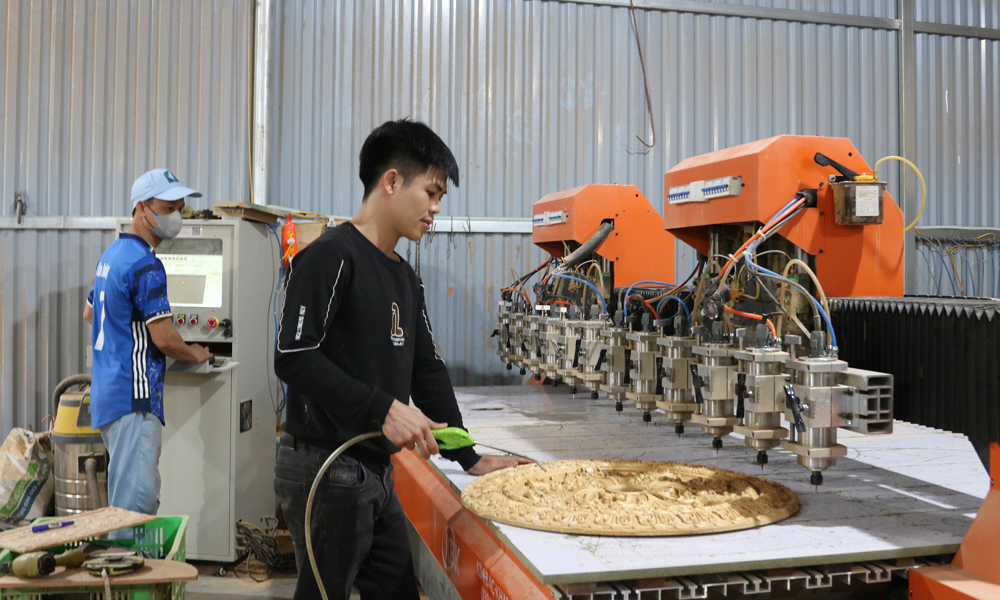
Nguyen Van Phong (right) by his computer-controlled CNC carving and cutting machine in Tram village. |
According to local authorities, the commune is home to about 687 households engaged in wood processing and production.
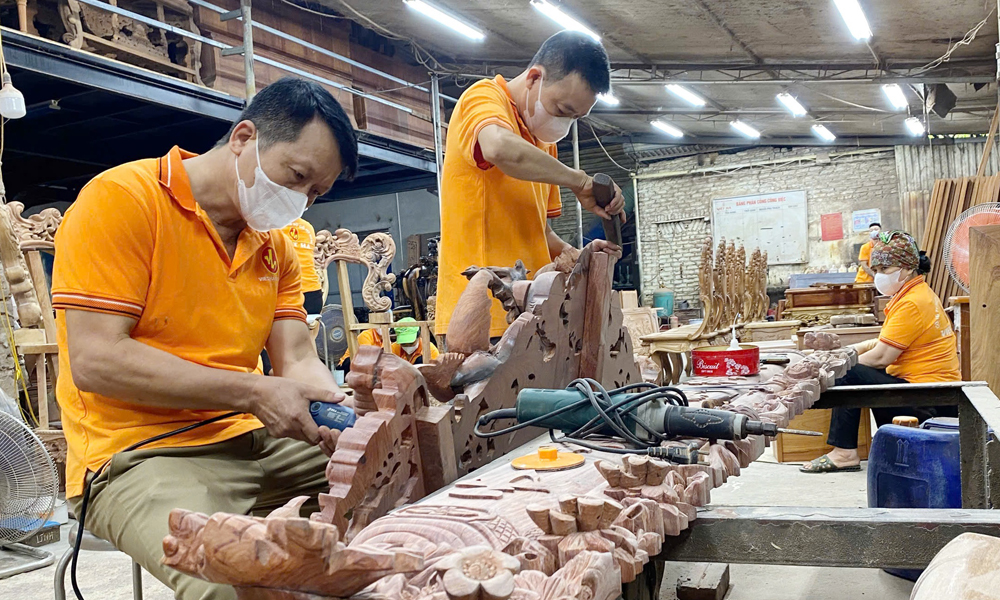
Activities range from pallet cutting and turning wooden cores for broom handles to manufacturing timber-frame houses, ceilings, wall panels and other wood products used in civil construction.
These workshops employ roughly 4,781 workers, with average monthly incomes ranging from 7 million VND to 15 million VND.
Annual revenues per facility are estimated at between 12 billion VND (458,000 USD) and 50 billion VND (1.9 million USD), contributing significantly to local budget revenues and economic growth.
Once a purely agricultural area, Tien Luc is steadily shifting its economic structure toward handicrafts and services.
Tram village is considered a standout example of that transformation. Of its 170 households, 120 are involved in wood production and installation, mainly wooden ceilings, stair railings and doors.
The sector provides stable jobs for around 600 workers, with average monthly incomes of about 12 million VND.
Village head Nguyen Van Sang said the craft began taking shape in 2011 and has expanded rapidly over the past seven to eight years. “In the past, Tram was the poorest village in the commune because families were large and farmland was limited,” he said.
“Thanks to the development of carpentry, living standards have improved markedly. The village is now among the most well-off in the commune.”
About 70% of households in the village now own cars, and only one household remains classified as poor, according to local officials.
A key factor behind the sector’s momentum has been the dynamism of younger craftsmen willing to invest in new technology.
Nguyen Van Phong, 24, is among the youngest workshop owners in Tram village. Coming from a disadvantaged background, he learned the trade from older generations and gradually built up his own facility.
He said he has signed 10 contracts to install wooden ceilings for clients both inside and outside the province. To meet rising market standards, he has invested heavily in machinery.
In 2025 alone, his workshop installed a computer-controlled CNC carving and cutting machine worth more than 200 million VND, along with high-tech sanding equipment. The upgrades have improved product durability and aesthetics while reducing manual labor and increasing efficiency.
Beyond household-scale workshops, larger enterprises have also emerged. Ngoc An Construction and Trading Co., Ltd., based in Tay village, specializes in timber-frame houses and restoration of historical sites. The company operates three workshops employing about 50 workers.
In 2025, the firm recorded revenue of more than 40 billion VND. In the first months of this year, it signed six contracts worth a combined 18 billion VND in production value.
Director Hoang Van Ngoc said the company invested 15 billion VND late last year to build a new 2,000-square-metre factory equipped with modern saws and conveyor systems, boosting productivity and reducing reliance on manual labor.
Alongside technological upgrades, producers have stepped up marketing efforts through social media and e-commerce platforms, helping them expand their customer base beyond the local market and secure more contracts across provinces.
 |
|
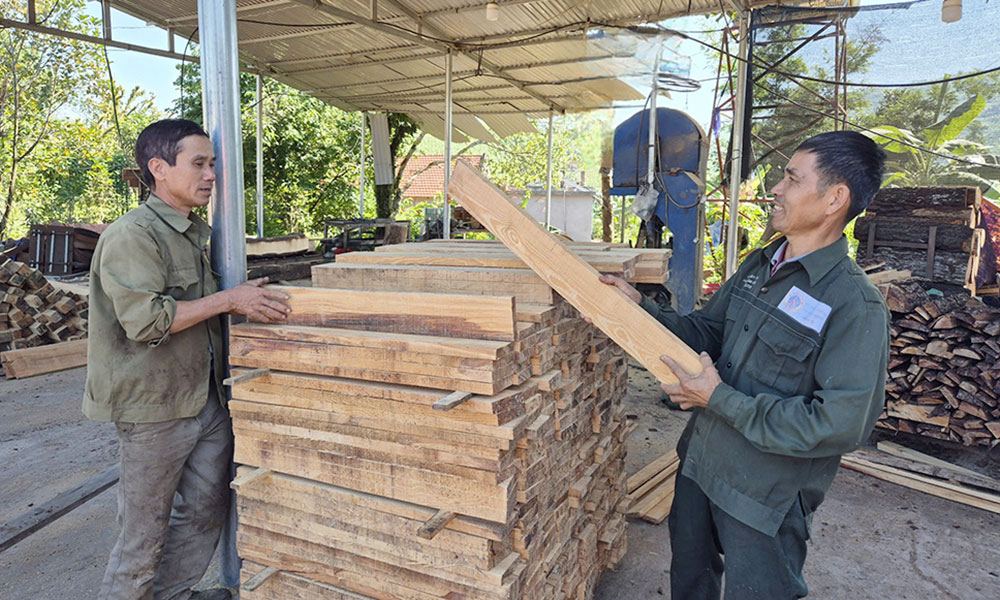
Workers at wood processing facility in Tien Luc commune are drying newly sawn planks in open yards to prevent warping and deformation during construction. |
Local authorities said the craft developed in response to growing demand for wood in housing construction, as homeowners seek warmer, more natural living spaces.
The commune has supported the sector by improving access to electricity and water, allocating material storage areas and promoting the village craft’s image.
In the coming years, Tien Luc plans to review and designate concentrated production zones to facilitate expansion while linking economic development with environmental protection.
The rise of wood production and installation in Tien Luc has not only delivered stable incomes but also altered the rural landscape, underscoring a broader shift toward technology-driven growth in Vietnam’s countryside.








Reader's comments (0)