 Bắc Ninh


Semiconductor training brought closer to industrial practice
The gap between university education and industrial processes remains a major bottleneck in semiconductor workforce training. Many educational institutions lack laboratories, licences for specialised electronic design tools, and funding to enable students to develop prototype chips.
The challenge is not simply to introduce new degree programmes or increase enrolment quotas, but to ensure that graduates are equipped with the skills needed to work in the industry.
 |
|
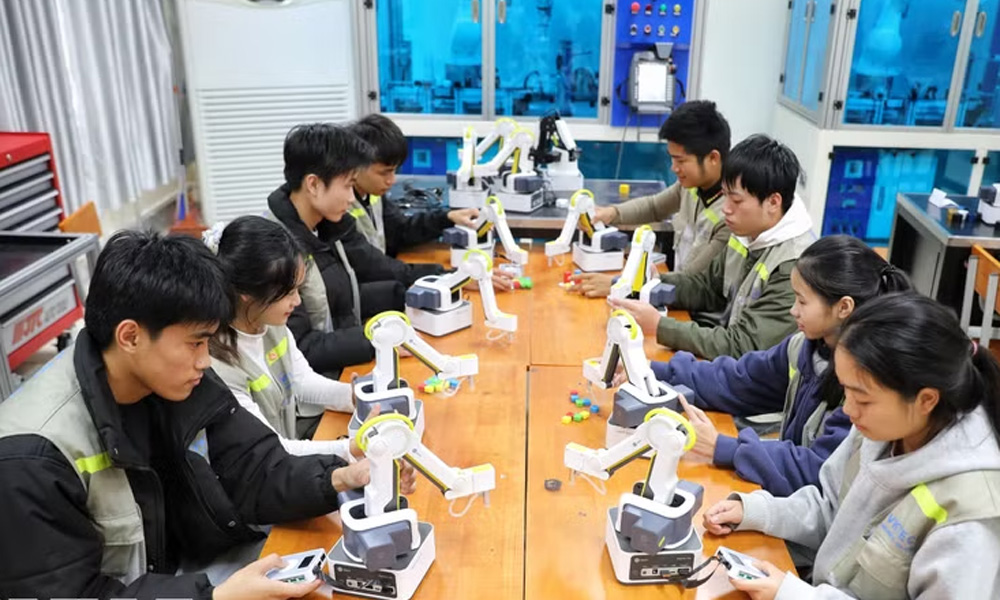
Semiconductor workforce training at Phenikaa University. |
The gap between theory and practice
Semiconductors form the core physical infrastructure of the digital economy, underpinning technologies such as artificial intelligence (AI) and big data.
The Politburo's Resolution No. 57-NQ/TW identifies science, technology, innovation and digital transformation as the foremost drivers of development.
Semiconductor workforce training is therefore directly linked to national competitiveness and technological self-reliance.
Semiconductor chip technology is among the 10 groups of national strategic technologies identified under the Prime Minister's Decision No. 21/2026/QD-TTg.
Viet Nam's Semiconductor Industry Development Strategy to 2030, with a vision to 2050, sets out the objective of developing human resources in close connection with the industrial ecosystem.
Universities are therefore required to expand training capacity while ensuring that graduates meet the standards demanded by global value chains.
According to Associate Professor Dr Le My Ha, Dean of the Faculty of Electrical and Electronics Engineering at Ho Chi Minh City University of Technology (HUTECH), cooperation between universities and businesses remains insufficiently developed.
Businesses are not yet extensively involved in curriculum development, internship arrangements, supervision of graduation projects or commissioning research.
Educational institutions also face shortages of highly qualified lecturers, while infrastructure and specialised software require substantial investment.
Financial mechanisms and commissioning arrangements remain inflexible, despite the sector's need for focused, long-term investment.
Another challenge arises from the interdisciplinary nature of semiconductor engineering. A semiconductor engineer must integrate knowledge of electronics, automation, circuit design, measurement and testing.
Associate Professor Dr Ngo Nhu Khoa, Rector of Thai Nguyen University of Technology, noted that semiconductor chip technology is still relatively new in Viet Nam, and lecturers have limited opportunities to gain exposure to industrial production.
Consequently, students may acquire knowledge in individual disciplines but lack an environment in which to connect the different stages into a complete industrial process.
Associate Professor Dr Nguyen Tan Tran Minh Khang, Rector of the University of Information Technology under Viet Nam National University–Ho Chi Minh City, said: "We are not yet able to train chip design engineers to a level approaching industrial requirements because the costs of investing in and operating chip design laboratories, as well as obtaining licences for industrial electronic design automation (EDA) tools used in teaching and research, are considerable. There is also insufficient funding to support outstanding students and postgraduate researchers capable of developing prototype chips."
The bottleneck lies not in the number of students or the availability of individual pieces of equipment, but in the conditions needed for students to gain practical experience across the entire process.
If students learn only isolated stages or stop at simulation, they will struggle to gain a comprehensive understanding of the steps from design and verification to prototype fabrication and testing.
Training programmes will also find it difficult to keep pace with industry developments without regular business involvement.
Expanding degree programmes and increasing enrolment must therefore go hand in hand with investment in practical training infrastructure and improvements in teaching capacity.
Sharing infrastructure and linking training funding to outcomes
Semiconductor workforce training must begin with identifying appropriate positions within the global value chain.
According to Associate Professor Dr Nguyen Van Quynh, Dean of the Faculty of Advanced Materials Science and Nanotechnology at the University of Science and Technology of Ha Noi, Viet Nam should prioritise its strengths in mathematics, information technology, electronics and engineering.
Particular attention should be given to integrated circuit design, testing, packaging, specialised software, and chips for applications in AI, the Internet of Things and telecommunications. These are areas in which Viet Nam could integrate more quickly into global value chains.
Clearly identifying priority stages would enable individual institutions to select suitable programmes, teaching staff and infrastructure, rather than developing similar courses independently.
In the longer term, Viet Nam should gradually strengthen its capabilities in materials research, fabrication technologies and specialised chips through cooperation among the State, universities, research institutes and businesses.
Associate Professor Dr Le My Ha stressed that curricula must be updated rapidly, aligned with international standards and closely connected to business needs.
Interdisciplinary training should integrate courses in electronics, information technology, automation and materials science.
Teams of lecturers should jointly develop a sequence of practical problems and projects, helping students understand the relationships between different production stages, select appropriate tools and verify design results.
Universities could invite engineers, businesses, international experts and overseas Vietnamese professionals to participate in teaching and supervising student projects.
Business involvement should be defined through specific responsibilities rather than cooperation agreements that remain merely statements of principle.
Businesses could provide practical problems, data and internship environments, while universities would ensure a solid scientific foundation and appropriate teaching methods.
Both sides should jointly monitor and evaluate project outcomes, provide feedback and adjust graduate competency standards.
The substantial investment required also calls for a restructuring of training infrastructure.
Instead of each university developing a self-contained system, regional or specialised networks of shared laboratories could be established, supported by mechanisms for sharing EDA tools, equipment and expert resources.
This approach would help concentrate investment, improve infrastructure utilisation and expand practical training opportunities for students from different institutions.
Training commissioning mechanisms should also shift their focus from enrolment numbers to graduate competencies and measurable outcomes.
Funding could be linked to the number of courses jointly designed with businesses, students completing projects that meet industrial requirements, and chip designs successfully fabricated, tested or developed into products.
Such an approach would provide a basis for more targeted resource allocation and help avoid fragmented investment.
Viet Nam's target of training approximately 50,000 semiconductor professionals with university-level qualifications or higher by 2030 presents significant challenges in both scale and quality.
The key is to ensure that graduates can participate in industrial processes and develop tangible products. Investment in laboratories and design tools, support for prototype chip fabrication, and closer alignment between training and business needs must therefore be implemented in a coordinated manner.












Reader's comments (0)