 Bắc Ninh


Vietnam outpaces regional peers in science: PISA 2025
Vietnam ranked second in Southeast Asia in science on PISA 2025, but a wide reading gap has the Education Ministry calling for a cross-subject literacy push.
Vietnam outscored every Southeast Asian participant except Singapore in science on the OECD's 2025 Programme for International Student Assessment, posting a score of 457 that placed it in a statistical tie with the United Arab Emirates and Malta.
 |
|
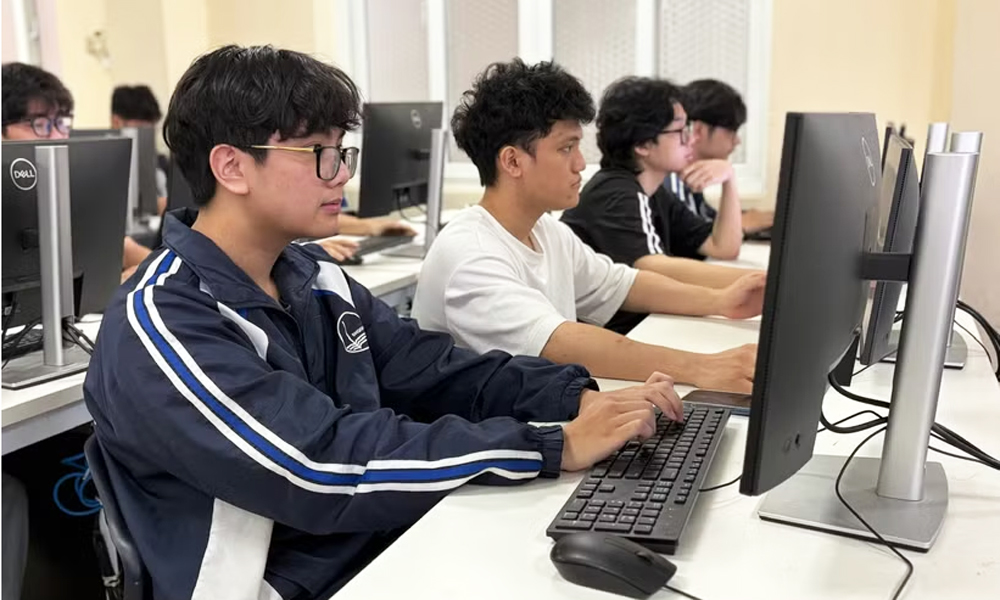
Illustrative image. |
Vietnamese students, 97%, also received supplementary science instruction outside regular classes – the highest rate of any participant in the assessment.
The assessment, known as PISA, tested roughly 760,000 15-year-olds across 91 countries and economies in 2025, measuring performance in science, reading, mathematics and computational problem solving.
Vietnam scored below the OECD average in all four subjects: 457 in science against an average of 482, 443 in mathematics against 463, 461 in computational problem solving against 500, and 392 in reading against 461 – a 69-point gap, the widest of the four.
Vietnam's results also showed a wide spread within its own student population. Just 4.2% of Vietnamese students reached the top two proficiency tiers, less than half the OECD average of 11.9%.
About a quarter scored below the baseline level PISA associates with the ability to apply core skills to everyday situations, compared with an OECD average of 19.7%.
The 2025 cycle was the first in which Vietnam administered PISA on computers rather than paper; it had used older paper-based test materials, based on the 2012 framework, in every prior cycle.
The Ministry of Education and Training says that change makes this year's results difficult to compare directly with past ones, and has cautioned against reading any score movement from previous cycles as evidence that education quality has risen or fallen.
The ministry says the results point to two priorities to be pursued together: raising basic competency levels for the broad student population, particularly in reading, while continuing to support students who perform at a high level.
Officials say reading should not be treated as the responsibility of literature teachers alone: solving a math word problem, interpreting a scientific phenomenon, reading a map or chart, and following instructions online all draw on the same underlying skills – identifying relevant information in a text, weighing it and drawing conclusions.
Reading instruction, they say, needs to be incorporated into every subject, not confined to language arts classes.
That guidance comes as Vietnam continues implementing its 2018 General Education Programme, a curriculum revision aimed at shifting classroom instruction from memorisation toward the application of knowledge.
The ministry says teaching and assessment methods need to continue moving in that direction.
The ministry is also calling for clearer guidance on how teachers and students use artificial intelligence tools, and for testing methods that can measure student ability independent of AI assistance.
PISA data show Vietnamese students' use of AI chatbots for schoolwork exceeds OECD averages across every task measured: 93.8% report using AI at least occasionally to help them learn generally, compared with an OECD average of 79%; 86.3% use it to summarise texts, against 68% OECD-wide; 88.3% use it to draft assignments, against 68%; and 81.8% use it to research new topics, against 71%.
About 70% of Vietnamese students say they have been taught how to evaluate AI-generated information.
Other measures in the PISA data show support for students has grown in Vietnam even as it declined elsewhere.
An index measuring students' reported support from science teachers rose by 0.31 points between 2015 and 2025, compared with an OECD-average increase of 0.03 points over the same period – one of the largest gains recorded among participating countries.
An index of family support rose by approximately 0.07 points between 2022 and 2025 in Vietnam, while the OECD average fell by roughly 0.18 points over the same period.
Reported access to school-based study support in Vietnam varied widely by type. Just 46.9% of Vietnamese students attend schools that provide dedicated space to complete homework, compared with an OECD average of 73.3%.
But schools offering peer-to-peer tutoring or staff assistance with homework were each reported by about 96% of Vietnamese students, well above OECD averages of 51% to 59%.
Socio-economic status accounts for a larger share of the variation in science performance in Vietnam, 17.5%, than it does across the OECD on average, 11.6%, though the score gap between advantaged and disadvantaged students, 87 points, is close to the OECD average of 85 points.
Gender gaps in Vietnam were smaller than OECD averages in both reading (25 points, versus 30 points OECD-wide) and mathematics (6 points, versus 13 points).
Other survey measures showed a mixed picture. Vietnamese students reported less distraction from digital devices during science lessons than the OECD average, 14.4% versus 28.4%, and lower rates of truancy, with 90.1% reporting little or no truancy compared with 66.1% OECD-wide.
But 51.8% of students showed a growth mindset, an index PISA uses to gauge whether students believe ability can be developed through effort, compared with an OECD average of 69.3%, and 52.3% said they believed their social status could change, compared with 66.4% across the OECD.
Vietnamese students also reported high engagement with environmental issues: 92.8% said they were interested in an environment-related career, compared with 61.6% across the OECD, and 93.5% said they had taken part in at least one pro-environmental activity in the past year, compared with an OECD average of 71.9%.


Reader's comments (0)