 Bắc Ninh


Bac Ninh races to train semiconductor workforce
BAC NINH - As the semiconductor industry faces a growing labour shortage, vocational schools in Bac Ninh province are racing to seize opportunities by expanding training programmes, increasing enrolment and adopting more flexible teaching models. These efforts aim to gradually improve workforce quality while opening up broader job prospects for young workers.
The chip and semiconductor industry has become a cornerstone of the digital technology era, underpinning the development of sectors such as electronics, automation, telecommunications and information technology.
 |
|
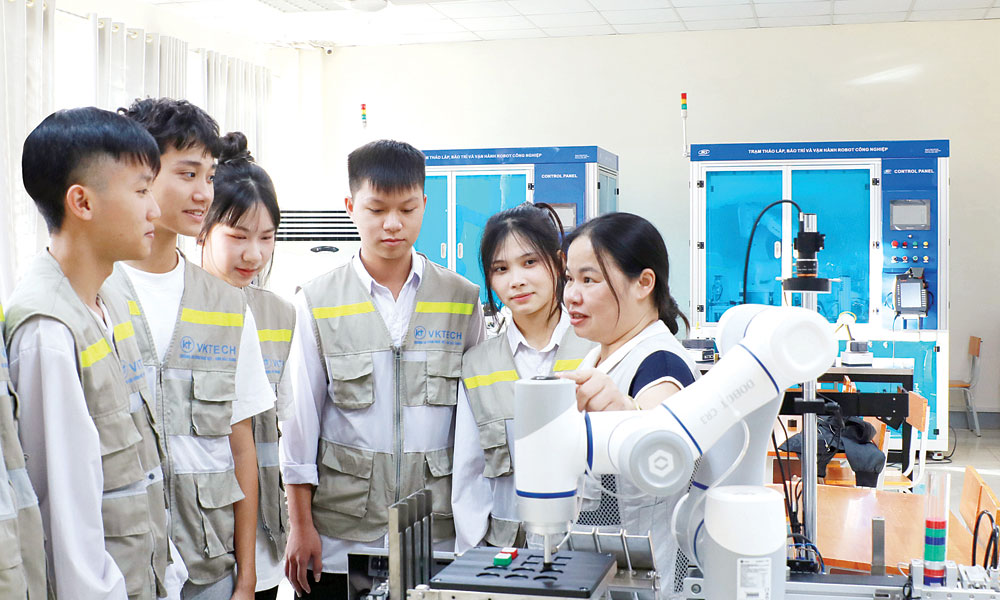
Students of the Industrial Electronics Faculty practise operating robots at VK-Tech. |
Rapid growth in the industry has created major economic opportunities and triggered a wave of attractive jobs, particularly for younger generations.
Bac Ninh currently has around 50 active projects in the semiconductor and near-semiconductor fields. From now until 2030, the province is expected to need between 3,000 and 5,000 workers annually for the sector. Despite strong growth potential, the industry is facing significant challenges related to human resources.
Nguyen Nhat Hong, director of the Human Resources Development Centre at the Bac Giang Korean–Vietnam College of Technology (VK-Tech), says the school has proactively and urgently moved to seize training opportunities to supply skilled labour for enterprises. Based on demand forecasts, the college has expanded programmes related to the semiconductor sector.
At present, seven of the school’s 13 training majors are linked to semiconductor-related fields, including electricity, electronics, information technology and mechatronics, with nearly 900 students enrolled. In the 2025–2026 academic year, the college is opening two new majors in mould manufacturing and industrial automation.
The school is also cooperating with Korea Polytechnics University to organise training and refresher programmes in semiconductor technology and artificial intelligence for lecturers and students.
As part of its ambition to become a high-quality vocational institution, the college has recently opened a semiconductor training centre, strengthened international cooperation and oriented student recruitment towards overseas training programmes.
Under one initiative, selected students will be sent to China to study semiconductor majors with partial funding support for tuition fees and living expenses.
With a long-standing tradition in vocational education, Bac Ninh College of Electromechanics and Construction has also taken proactive steps to align training with labour market demand.
Nguyen Quoc Huy, the school’s principal, says the management board has focused on improving facilities while encouraging lecturers to innovate teaching methods and design curricula that closely simulate real production environments.
Training programmes are tailored to meet specific job requirements at factories, helping students adapt quickly after graduation. In the 2025–2026 academic year, the college has more than 1,600 students.
Notably, 138 students are being trained under an order-based model with Goertek Group using the “1+1+1” approach.
Under this model, students spend their first year studying theory at school, the second year practising at enterprises and the third year participating directly in production processes. In addition, 35 students are enrolled in a high-quality training programme specifically focused on the semiconductor industry.
According to the Department of Education and Training, Bac Ninh currently has 114 vocational education institutions, including 32 colleges, 35 intermediate schools, 29 centres and 18 other vocational training providers.
During the 2021–2025 period, the province achieved notable results in vocational training and workforce quality improvement, particularly in semiconductor and near-semiconductor industries. The proportion of trained workers across the province has reached 80%, with 35.9% holding degrees or certificates.
Employment outcomes have also been positive, with 80–90% of students securing jobs after graduation. In several semiconductor-related fields, including electrical and electronic engineering technology, automotive technology and automation, enterprises have recruited 100% of graduates.
 |
|
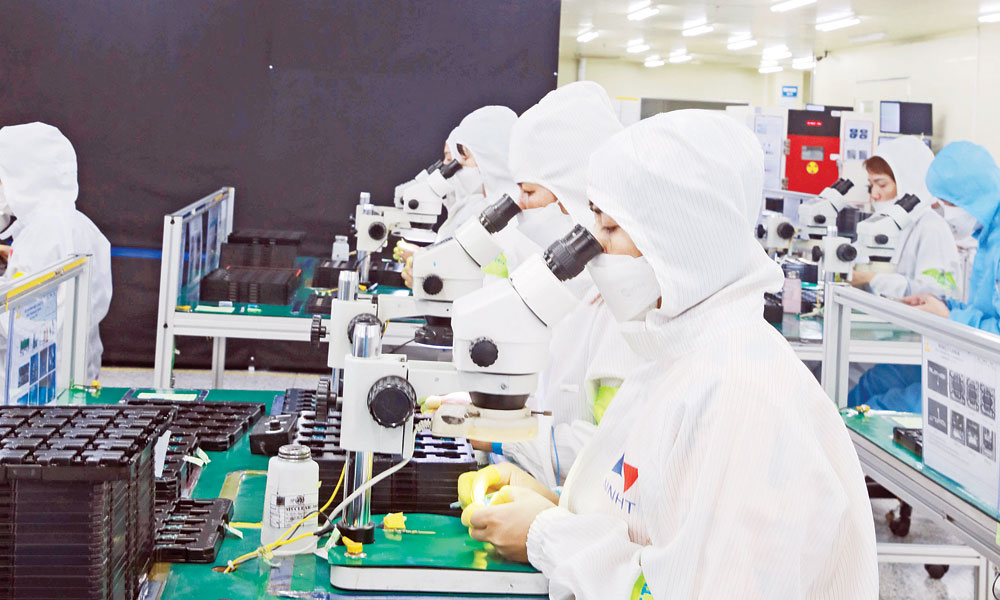
A production line operates at Nano Hightech Vietnam Co., Ltd. |
With a population of more than 3.6 million people, over 60% of whom are of working age, Bac Ninh has identified workforce development as a key pillar of its industrial strategy. The province has adopted training plans targeting support for around 3,000 lecturers and university-level and postgraduate students, as well as approximately 2,500 workers, by 2030.
These programmes focus on disciplines serving the semiconductor industry, information technology and artificial intelligence.
Local authorities view vocational education as a critical link in addressing labour shortages and sustaining the province’s role as a major manufacturing hub in northern Vietnam.
By strengthening links between training institutions and enterprises, expanding international cooperation and aligning curricula with industry needs, Bac Ninh aims to build a skilled workforce capable of supporting the rapid expansion of high-tech industries in the years ahead.









Reader's comments (0)