 Bắc Ninh


Solar power for sustainable agriculture
Solar energy is emerging as a leading trend in the renewable energy sector, particularly as technological costs fall sharply and the global shift towards renewables accelerates. One of the most common ways to convert solar energy into electricity for human use is through solar photovoltaic panels.
However, experts warn that the development of solar power plants worldwide has revealed significant environmental and land-use limitations.
 |
|
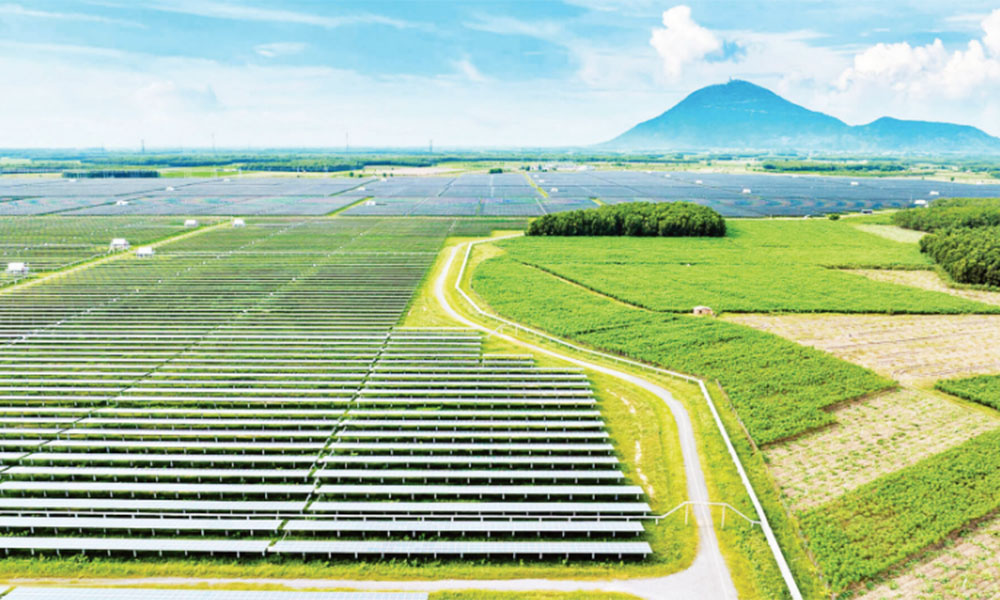
The Dau Tieng solar power plant in Tay Ninh Province. |
The photovoltaic manufacturing process uses hazardous chemicals such as hydrochloric acid, sulphuric acid, nitric acid, and hydrofluoric acid, which pose health risks, especially to factory workers.
A report by the US Institute for Energy Research (IER) indicates that solar panels generate 300 times more hazardous waste than nuclear power plants when compared on the same unit of energy output.
Solar panels also contain heavy metals such as lead, chromium, and cadmium, which can harm the soil environment if they are crushed and buried in landfills.
In addition, utility-scale solar panels occupy large areas of land, inhibiting vegetation growth underneath and turning these zones into “dead land”.
In Viet Nam, solar power has expanded rapidly in recent years, especially in Ninh Thuan — regarded as the country’s “solar capital”. This boom has occurred against the backdrop of fast economic growth, soaring energy demand, and rapidly falling technological costs.
However, large-scale solar projects are consuming vast tracts of land and exerting pressure on the environment. Most projects still lack end-of-life treatment plans for their panels, even though these devices contain materials and heavy metals that may cause pollution if simply buried.
Globally, many research groups have sought to overcome the limitations of flat-panel solar power by using concentrated solar power technology. This approach focuses sunlight into a small area, significantly reducing the amount of photovoltaic material required.
A group of Chinese scientists was among the first to propose a model that separates components of sunlight, reserving red and blue light for agriculture while converting the remainder into electricity.
However, this model is extremely costly as it requires expensive nano-optical films to split the light, offers low durability, and achieves a concentration ratio of only a few dozen times, making it suitable only for laboratory settings.
Recently, a team from Phenikaa University developed a new approach that addresses these shortcomings and is better suited to real-world conditions.
The work was carried out under a project titled “Research, design and fabrication of an environmentally-friendly agrivoltaic system based on concentrated solar technology”, funded by the National Foundation for Science and Technology Development (Nafosted).
Associate Professor Vu Ngoc Hai, the project leader, explained that instead of using parabolic troughs to concentrate light along a line, the research team employed Fresnel lenses, thin, lightweight, and inexpensive non-imaging optical components capable of focusing light onto a small point with a concentration ratio of up to several hundred times.
When light is compressed to such an extent, the area of photovoltaic cells required is hundreds of times smaller, meaning less material, fewer toxic chemicals, reduced waste, and lower costs. This Fresnel lens is itself an invention derived from the project.
Associate Professor Hai added that at the focal point, the team positioned a semi-coated mirror to separate components of natural sunlight. Red and blue light, two wavelengths strongly absorbed by plants, pass through the mirror to reach the cultivation area.
The remaining light, especially infrared light carrying substantial thermal energy, is reflected back and directed onto a high-efficiency solar cell.
Separating the light at a single small point reduces the surface area that needs coating by 25 to 30 times, enabling the use of cheaper and more durable optical film technologies suitable for industrial production. This is a key improvement over existing international technologies.
The extracted red and blue light is delivered through fibre optics and redistributed using non-imaging optical structures. As a result, the light reaching the crops is uniform, creates no shading, and does not reduce yields, unlike systems that space panels apart or mount panels on greenhouse roofs.
The high-energy portion of the sunlight, which is reflected, is converted into electricity with greater efficiency than conventional flat-panel systems.
According to the research team, this technology opens new possibilities for agrivoltaic models in Viet Nam, particularly in regions with high solar radiation and demand for integrated electricity production and farming.
In the next stage, the team aims to further improve the system to assess real-world applicability, with a view to transferring the technology to enterprises and agrivoltaic models nationwide.
To ensure feasibility when scaled up, the team has cooperated with Myongji University in the Republic of Korea, a leading institution in optics, materials, and renewable energy, to jointly develop a fully functional prototype at a pilot scale.
This collaboration has enabled performance measurements under different environmental conditions, including the tropical climate of Hanoi and the temperate climate of Seoul, assessing the durability of Fresnel lenses and optical films as well as verifying the stability of light distribution on crops.
Initial results show that the system achieves higher energy-conversion efficiency than traditional flat-panel models under the same solar radiation conditions, while supplying sufficient red-blue light for plant growth without causing localised shading or reducing productivity.
These early achievements have been published in the Q1-ranked international journal PLOS ONE.
According to representatives of the National Foundation for Science and Technology Development, the research not only demonstrates the feasibility of next-generation agrivoltaic technology but also opens significant opportunities for Viet Nam to join the group of countries possessing concentrated solar power technology for sustainable agriculture.
With plans to further optimise optical materials, reduce costs, and build larger prototypes during the 2025–2027 period, the system is expected to undergo field trials, be transferred to businesses, and contribute directly to Viet Nam’s goals for green agriculture, the circular economy, and renewable energy development.







.jpg)


Reader's comments (0)