 Bắc Ninh


Bac Ninh steps up semiconductor workforce training to meet industry demand
BAC NINH - Bac Ninh aims to train around 30,000 semiconductor workers by 2030 as it moves to meet growing demand from businesses in the sector. Educational institutions are updating training programmes to keep pace with industry trends, while local authorities have introduced support policies to encourage students to pursue priority fields and strengthen the quality of its future workforce.
Recognising the growing demand for workers in the semiconductor and related industries, Vietnam-Korea Bac Giang College of Technology (VKTECH) began developing semiconductor training programmes in 2023.
 |
|
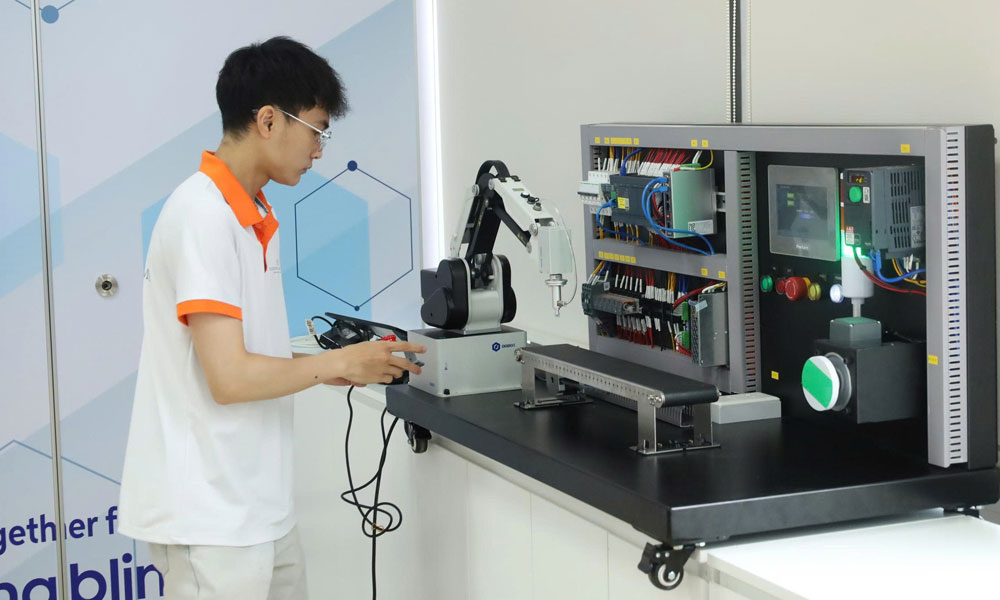
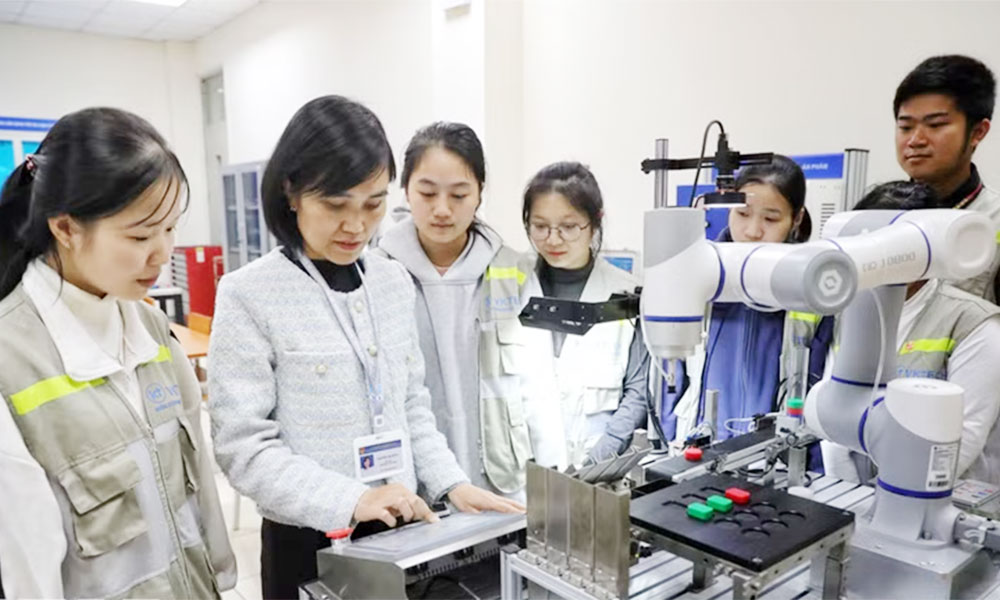
Students at the Vietnam-Korea Bac Giang College of Technology practice with robots during a semiconductor class. |
That year, the college partnered with Hana Micron Vina Co., Ltd. to train 100 students majoring in industrial electrical engineering, information technology and electronics. The programme, which focused on semiconductor packaging and testing, ran from October 19, 2023, to July 19, 2024.
The two sides jointly delivered the programme, with students attending classes at the college and company experts visiting the school each week to provide specialised training.
Upon graduation, students who completed the programme were recruited by Hana Micron at a salary one level higher than that offered to other college graduates who had not participated in the programme.
In October 2024, the college opened a second class and has since organised annual internships for students in semiconductor-related fields. To date, nearly 200 skilled technicians have been employed by the company.
The college has also partnered with Goertek Vina to train electronics students under a 1+1+1 model. Students spend their first year studying at the college, their second year studying at both the college and the company’s training centre, and their third year gaining hands-on experience at the company. Upon graduation, they will work for Goertek at a salary equivalent to that of university graduates.
In April 2026, Samsung funded the establishment of a Samsung Innovation Campus (SIC) Lab at the college. Shortly after its launch, Samsung, in cooperation with several companies and VKTECH, began providing free training for college students in artificial intelligence, Big Data, semiconductors and the Internet of Things. The centre aims to train 400 students by November 2026.
In Bac Ninh, a number of other educational institutions are also involved in semiconductor training.
To help meet the city’s target of training around 30,000 semiconductor workers by 2030, East Asia University of Technology has begun offering semiconductor training based on its electrical and electronic engineering programme, with a focus on semiconductor engineering.
The university began enrolling and training students in the semiconductor field in 2025. Over the next five years, it expects to train around 200 students. Enrollment will be adjusted in line with the university’s training capacity and actual demand for skilled workers.
Dr. Dinh Van Thanh, President of East Asia University of Technology, said the university had recently attended a Vietnam-Taiwan (China) semiconductor workforce development forum.
Participants discussed training, research, technology transfer and international internship programmes, and signed a memorandum of understanding on cooperation.
Potential areas of cooperation include transfer programmes, joint master’s and doctoral training in Taiwan, and access to scholarships under Taiwan-funded initiatives.
The university is also promoting academic exchanges with educational institutions in the Republic of Korea that offer semiconductor programmes.
To encourage workforce development for the semiconductor industry, the Bac Ninh People’s Council issued Resolution No. 113/2025/NQ-HDND on December 10, 2025, setting out policies to support vocational training and workforce development for the semiconductor, artificial intelligence and digital technology industries during 2025-2030.
The policy aims to encourage students to pursue fields that the city has identified as development priorities.
According to preliminary figures compiled by the city’s Department of Education and Training, an estimated 1,800 students enrolled in semiconductor and semiconductor-related programmes in 2026 will be eligible for support under Resolution 113, with total funding estimated at around 18.6 billion VND (715,784 USD).

















Reader's comments (0)