 Bắc Ninh


Cultural identities of etthnic minority people during Tet festival
|
|
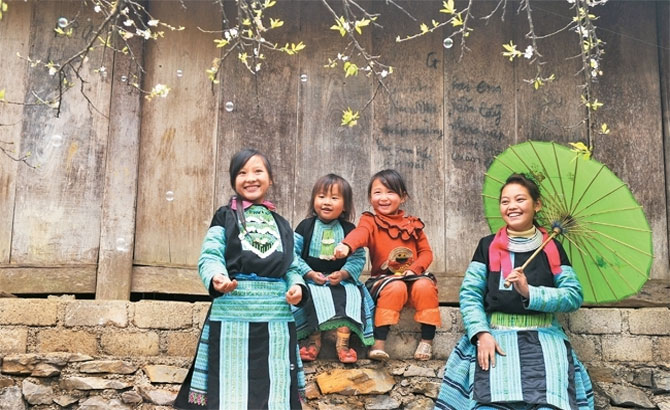
Mong ethnic children welcome the spring. |
For the Ha Nhi ethnic minority people in the northern moutainous province of Dien Bien, banh giay (a white, flat, round glutinous rice cake with a chewy texture) is a traditional food offered to guests during the Tet holiday. Surely, people who have the chance to enjoy this kind of cake will remember its taste forever.
Nong Thi Bich Van was born and raised in Hanoi, but her hometown is in a Nung ethnic minority area in the northern moutainous province of Cao Bang. Despite developments and changes in their society, the Nung people still preserve the spirit of their customs. For example, in Cao Bang, sons-in-law have to present their parents-in-law with a couple of chickens for Tet and a couple of ducks on the occasion of the full-moon day of the seventh lunar month. Living in Hanoi, where it is very difficult to feed chickens and ducks, Van’s husband presents her parents with salted pork legs for Tet and roasted ducks.
Due to the distance, Van can not regularly return to her hometown to celebrate Tet. She passed Tet in her hometown for the first time about ten years ago. She is very fond of the market full of people in the days before Tet. Last year, Van went back her hometown to not only welcome Tet but alo to join a 73-year-old longevity celebration for her dad, Nong Dinh Nhat. Van and her sister were taught to roll their hair in the Nung people’s style and they wore traditional clothes. Afterwards, all the members of the family gathered together to make banh giay in preparion for the celebration.
Cakes were used to worship ancestors and deities, and they had to be decorated with patterns painted by an ink made from mung toi (“malabar spinach”). In addition, a roasted pig and four or five roosters were also food for worshipping rituals. Because the longevity celebration took place on the occasion of Tet, banh tai—a kind of cake like banh chung (a kind of square glutinous rice cake) was among the offerings.
Van always remembers the rituals for children during her father’s longevity celebration. Each child would preapre a bag of rice and a little money and put them on an offering tray, which symbolised the children’s contributions to taking care of their parents. After the traditional rituals, the parents would sit on two chairs and the children would kneel in front of their parents to offer them a bowl of gruel and a glass of wine, respectively.
That was the first time Van knelt in front of her parents, so she was very moved. Last year’s Tet was the greatest memory for all members of Van’s family. It can be seen that many ethnic minority people, like Van, remember and consider the ancient customs as their traditions.
The Mong ethnic minority people also have a separate way of welcoming Tet. They like colours very much. The image of Mong girls and boys with cheerful faces and colourful clothes along the slopes of terraced paddy fields leaves a good impression on visitors.
Even Mong people acknowledge that there have been many changes in their Tet celebration. In the past, they celebrated the Tet festival earlier than the majority Kinh people. However, nowadays, many Mong people work and study according to the State’s schedule, so the time for their Tet festival has been gradually shifted to conform with the national Tet holiday. Despite numerous changes, the specific features of the Tet festival of Mong ethnic minority people have been preserved.
For the Mong people’s traditional Tet festival in Mu Cang Chai District, pa du (a cake made of pork and the leaves of a specific tree found in the mountainous district) is an indispensable food. The minced lean pork is mixed with salt and omental fat and wrapped in du leaves, then fried in a pan full of fat.
During the Tet holiday, the Mong people sit around a wood stove outside to fry and enjoy pa du cakes as well as to drink wine. They do not eat vegetables because they believe that if they pick vegetables during Tet, green grass will grow so that they cannot cultivate.
Many people have enjoyed thit trau gac bep (dried buffalo meat) in Bac Ha District, Lao Cai Province; however, many of them do not know thoroughly the way to enjoy this food. Gia, a man from the Dao ethnic minority group in the locality, said that the meat should be soaked for a while, sliced and then fried with garlic.
The Tet festivals of ethnic minority groups have undergone changes due to the modern society; however, the cultural values and traditional food are still carefully preserved. Just a pa du cake or the ritual of wine offering can create the beauty of the traditional Tet festival.
Source: NDO


Reader's comments (0)