 Bắc Ninh


Vietnamese scientists in Hong Kong solve 20-year-old biology puzzle that opens new doors for cancer therapy
Three Vietnamese researchers in Hong Kong have solved a 20-year puzzle in molecular biology that could reshape how scientists develop cancer treatments based on RNA interference.
Their study, published in Nature on March 4, reveals that the enzyme DICER, a key player in gene silencing, possesses a second binding pocket that scientists had missed for two decades. The discovery rewrites the textbook understanding of how cells produce microRNAs, the tiny molecules that switch genes on and off.
 |
|
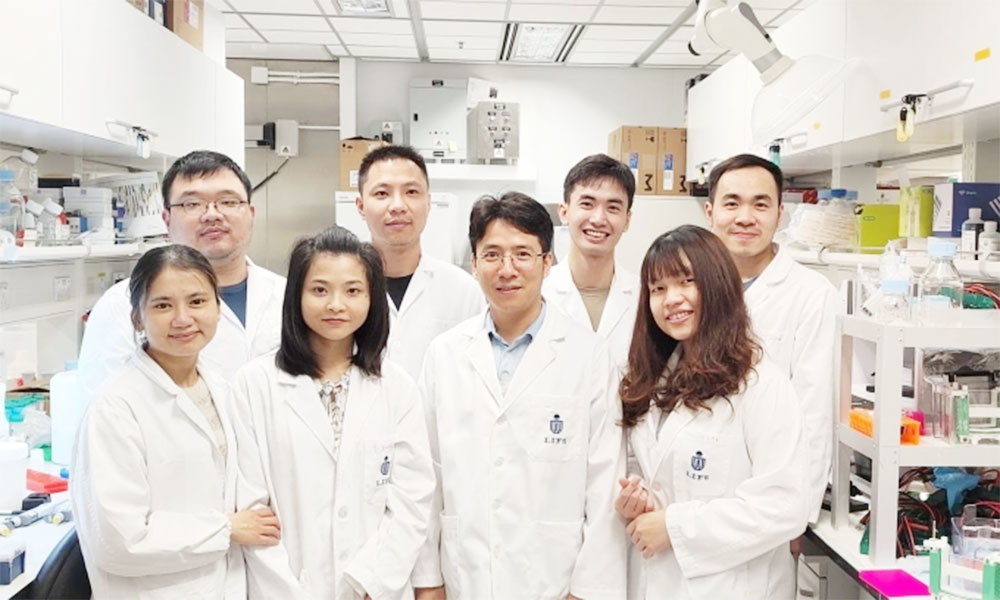
Associate Professor Nguyen Tuan Anh (front, 3rd L) with PhD students Ngo Minh Khoa (back, R) and Le Cong Truc (back, 3rd L), whose study on cancer therapy was published on Nature on March 4, 2026. |
The research was led by Associate Professor Nguyen Tuan Anh in the Division of Life Science at the Hong Kong University of Science and Technology (HKUST), with PhD students Ngo Minh Khoa and Le Cong Truc as co-authors.
DICER works like a biological scissor, cutting RNA precursors at precise locations to produce functional microRNAs.
For 20 years, scientists believed the enzyme relied on a single binding pocket at the 5'-end of RNA to determine where to cut.
But that pocket favored uridine and disfavored guanosine, one of RNA's four building blocks, leading to cleavage errors that no one could fully explain.
The HKUST team combined biochemical methods developed in their lab over nine years with cryo-electron microscopy (cryo-EM), which allowed them to observe RNA binding to DICER at the atomic level.
They found a second, previously unknown pocket that specifically recognizes guanosine, working in tandem with the first to ensure precise cuts across a wider range of RNA substrates.
"This enzyme is far more flexible in changing its shape than scientists previously knew," Khoa, the paper's first author, said.
The team also discovered that when conflicts arise between the two binding pockets and other RNA structural signals, the RNA itself undergoes conformational adjustments to preserve accurate cutting, a self-correcting mechanism that had never been described before.
The findings matter beyond basic science. RNA interference (RNAi) therapies, which harness the body's gene-silencing machinery to treat diseases, have gained momentum in recent years with several approved drugs for conditions from hereditary disorders to high cholesterol.
But designing effective RNAi-based treatments requires a precise understanding of how DICER processes its targets, exactly the knowledge gap this study fills.
Assistant Professor Kwon Sung-Chul, an RNA specialist at the School of Biomedical Sciences, University of Hong Kong, described the work as a missing piece in molecular biology that opens new doors for therapeutic approaches, particularly in cancer treatment.
The path to Nature was grueling. Tuan Anh described the decision to invest in cryo-EM as a risky turning point, and the team endured more than three years of setbacks. Without dedicated computing facilities, the PhD students often worked through the night to use machines in other labs.
"I have always believed that Vietnamese intellect is fully capable of competing on equal footing with international peers in experimental science, if given the right opportunities and direction," Tuan Anh said.
He has previously published twice in Cell, the world's leading biology journal. One of those studies was named among the top 10 scientific achievements of 2015 by the Korean Federation of Science and Technology Societies (KOFST).
Khoa remains a PhD student at HKUST, while Truc has graduated and is doing postdoctoral work in Switzerland.









Reader's comments (0)