 Bắc Ninh


Vietnamese soul in Bac Ninh artisan’s mother-of-pearl inlay art
BAC NINH - In the quiet village of Hoai Trung in Lien Bao commune, Bac Ninh province, artisan Nguyen Dinh Vinh has spent more than three decades preserving the essence of Vietnamese history and culture through intricate mother-of-pearl inlay. Despite the ups and downs of the craft, his passion continues to shine - much like the iridescent shells embedded in each of his works.
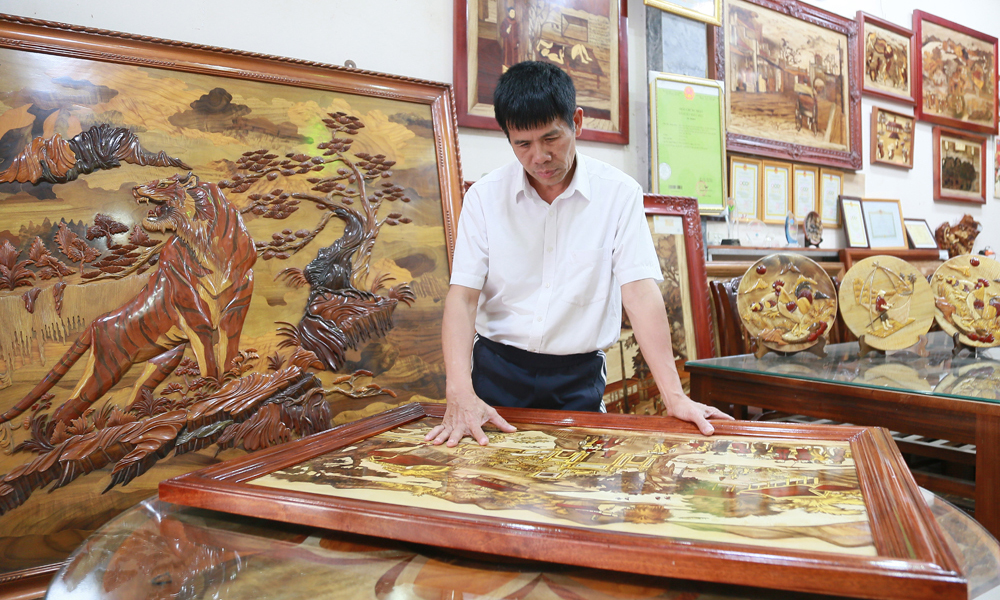
Inside his workshop, a calm and elegant atmosphere contrasts with the bustle outside. Under warm yellow light, lacquered panels, parallel sentences, antique furniture, and decorative plates shimmer with subtle rainbow hues.
 |
|
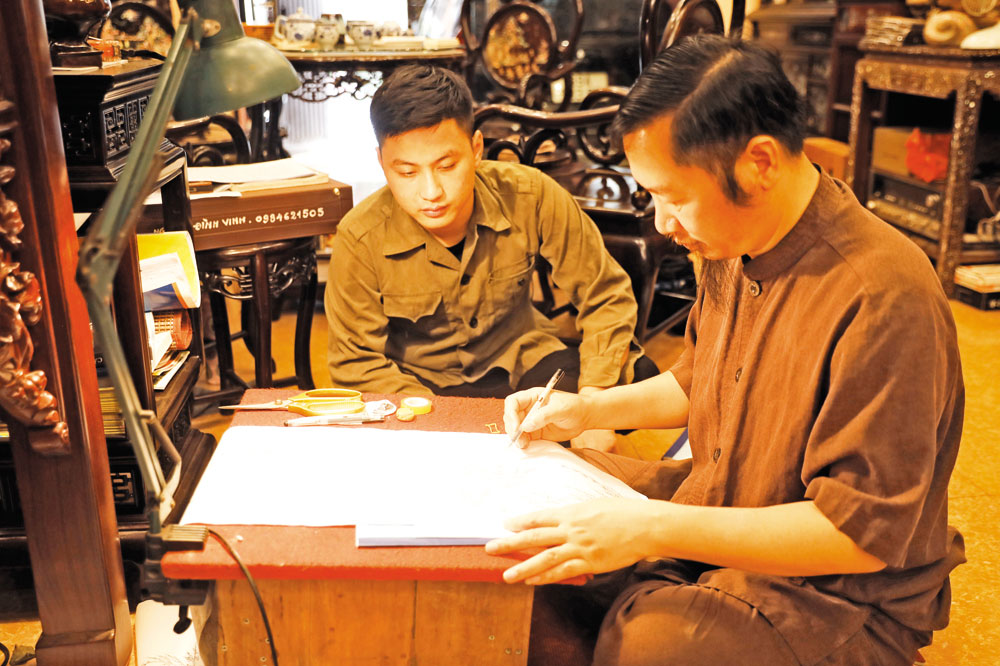
Vinh passes on his craft to his son. |
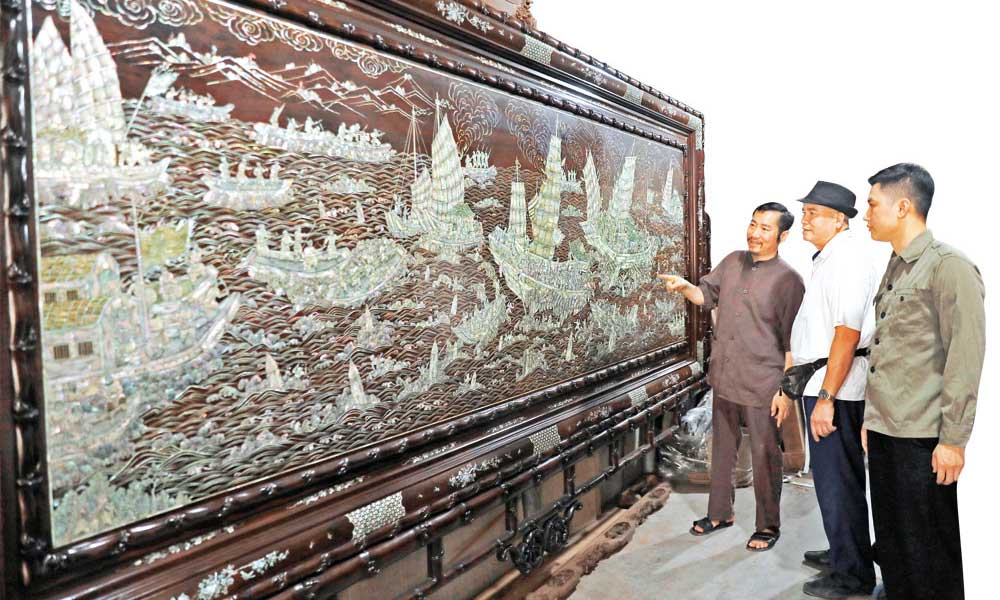
On dark wooden surfaces, scenes of rural life, festivals, birds, and traditional Quan ho folk singing come alive. Larger works vividly depict historic moments such as the Battle of Bach Dang, while portraits of national leaders are rendered with minimalist yet expressive inlay techniques.
Under the artisan’s skilled hands, everyday objects such as pendulum clocks, wooden vases, bodhi leaf-shaped carvings, traditional meal trays with ancient patterns, and even bronze drums are inlaid with mother-of-pearl, transforming them into works of rich artistic value.
In a small corner, Vinh carefully sketches each detail on tracing paper. His pen seems to guide viewers into the vibrant atmosphere of Kinh Bac village festivals, the grand celebrations of Thang Long imperial past, and legendary tales preserved through generations.
Noticing visitors, he paused his work and began introducing each piece with quiet enthusiasm.
“I spent a great deal of time thinking before creating this work,” Vinh said. “I asked myself why earlier artisans focused mainly on classical Chinese legends such as Sangu Caolu or the Peach Garden Oath, instead of bringing Vietnamese history into mother-of-pearl inlay art. After many nights of reflection, I decided to boldly choose themes rooted in Vietnam’s own culture and history.”
He shared that he consulted historians to ensure historical accuracy, from the shape of boats and soldiers’ uniforms to the inscriptions on the flags of the Nanhan, Song, and Mong–Yuan armies in his series on the three famous Bach Dang battles.
From his personal reflections, Vinh developed his own artistic direction: incorporating the nation’s history of building and defending the country, along with traditional local culture, into his inlay artworks.
He has since created many highly valued pieces. Works such as Chieu doi do (Royal Edict on the Transfer of the Capital) and Ve mien quan ho (Return to the Land of Quan ho) have been exhibited at the Millennium Anniversary of Thang Long and other major national events.
Notably, three of his works - Uncle Ho Reads the Declaration of Independence, Uncle Ho Visits Bac Ninh, and The Fierce Battle of Bach Dang River - have been recognised as records by the Vietnam Book of Records.
According to Vinh, mother-of-pearl inlay materials are not limited to domestic shells; they also include imported varieties. There are many types of shells used in the craft.
Alongside regular shell materials, red shells are especially prized for their luxurious and rare colours. They are often used to depict mountainscapes, phoenix wings, dragon scales, or decorative motifs on royal costumes.
In his workshop, Vinh prefers shells imported from Singapore for their vibrant colours, which are particularly suitable for the historical themes he pursues.
As he gently runs his hand over a nearly completed lacquer plate, he explains: “One of the most important stages is can xa cu - the inlay process. It means carving the wooden surface according to the design, then embedding pieces of shell into it. After that, the work is trimmed, polished, ground, engraved, and shaded to create depth.”
He added that the most meticulous stage in the craft is cutting and shaping the shell pieces. Artisans must manually grind, soak, heat, split, and carefully select each fragment to match the artwork’s surface.
A distinctive feature of Vinh’s works is that the shell pieces are never broken or rough; they are either perfectly flat or carefully curved to fit each composition. Carving and inlaying are executed with high precision and refined detail.
Vinh believed that beyond diligence and creativity, a mother-of-pearl artisan must also possess strong artistic sensitivity. In addition to composition and drawing skills, craftsmen must have “skilled hands and discerning eyes,” carefully selecting shell colours for each section of the artwork.
 |
|
Vinh introduces the mother-of-pearl inlaid artwork “The Fierce Battle on the Bach Dang River.” |
This is essential because mother-of-pearl reflects different colours depending on the viewing angle.
At the Bac Ninh Trade and Tourism Fair 2026, ceramic artist and artisan Luu Xuan Khuyen praised Vinh’s works, saying he has “golden hands” for mastering such a difficult material in visual art.
As the afternoon light fades, the countryside continues to transform with industrial development. Yet inside the small workshop in Hoai Trung village, the steady sounds of grinding and carving continue.
The shimmering shell fragments still glint under the light, and the artisan’s hands remain patiently assembling tiny pieces like piecing together fragments of historical memory.
It is this persistence that defines the craft of a master artisan, keeping the tradition of mother-of-pearl inlay alive for future generations.


Reader's comments (0)