 Bắc Ninh


Household savings hit record as high interest rates attract idle money
Household deposits at banks reached a new high of 10.8 quadrillion VND (414 billion USD) at the end of May, up more than 108 trillion VND from April and increasing by 4.76% from the beginning of the year, equivalent to nearly 492 trillion VND.
Household deposits at credit institutions climbed to a new record at the end of May, as higher deposit rates and weak returns from other investment channels encouraged savers to keep their money in the banking system.
 |
|
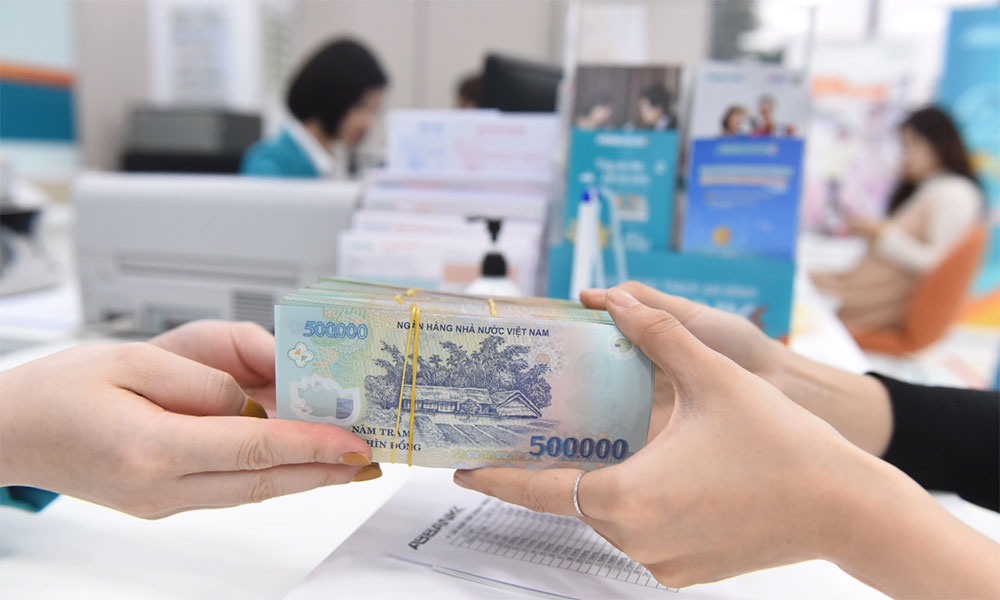
Illustrative image. |
The latest updates by the State Bank of Vietnam (SBV) show that household deposits at banks reached a new high of 10.8 quadrillion VND (414 billion USD) at the end of May, up more than 108 trillion VND from April and increasing by 4.76% from the beginning of the year, equivalent to nearly 492 trillion VND.
This increase comes as deposit rates have risen steadily since late 2025, encouraging households to move idle funds into bank savings for capital preservation and higher returns amid subdued performance in the stock, property and gold markets.
Corporate deposits, meanwhile, stood at more than 6.16 quadrillion VND at the end of May.
While they rose by 92.3 trillion VND from the previous month, they remained about 12 trillion VND, or 0.2%, below the level recorded at the end of 2025.
The SBV's report shows that average deposit rates in June range from 0.1–0.2% per year for demand deposits and terms of less than one month, 4.0–4.6% for one- to under six-month deposits, 6.1–7.6% for six- to 12-month terms, 5.9–7.3% for deposits of more than 12 months to 24 months and 7.1–7.8% for terms exceeding two years.
Several commercial banks are currently offering effective rates of more than 9% per year for six-month deposits through promotional programs and online channels.
External factors, including interest rate policies by the US Federal Reserve and the Bank of Japan, as well as exchange rate volatility, are also limiting room for domestic deposit rates to decline, he pointed out.
SBV data shows that outstanding credit reached nearly 20.1 quadrillion VND as of July 13, up 7.86% from the end of 2025.
Deposit mobilisation is lagging credit growth by about two percentage points, meaning that the banking system is facing a funding shortfall estimated at up to 2 quadrillion VND, forcing banks to rely on other funding sources to bridge the difference, the central bank said.
Dao Minh Tu, Vice Chairman and Secretary General of the Vietnam Banks Association, said the banking system is facing a mismatch between capital supply and demand, as funding needs continue to outstrip deposit growth.
The challenge is not liquidity or banks' ability to meet deposit withdrawals, but how to maintain a sustainable funding structure to support robust credit demand.
To address funding pressures, banks have stepped up competition for deposits by raising interest rates, offering promotional schemes, issuing high-yield certificates of deposit and increasing bond issuance to strengthen medium- and long-term funding.
Dang Ngoc Duc, Director of the Institute of Financial Technology at Dai Nam University, said the banking system faces a structural maturity mismatch, with around 80% of deposits concentrated in terms of less than six months, while demand for medium- and long-term lending remains strong.
Analysts at MB Securities (MBS) said the gap between credit and deposits expanded by more than 40% from the end of 2025, keeping the banking sector's overall loan-to-deposit ratio high and increasing liquidity pressure.
MBS said the gap between deposit mobilisation and credit growth is unlikely to narrow in the short term.
Banks will therefore need to maintain attractive deposit rates to strengthen funding, ease liquidity pressure and comply with prudential requirements, the company said.
While lending could ease selectively for priority sectors such as manufacturing and exports in the second half of the year, deposit rates are expected to remain elevated rates and may only edge lower toward the end of the fourth quarter if liquidity conditions improve significantly.
Deputy Prime Minister Nguyen Van Thang at the Government's meeting in May asked the banking sector to keep lending rates as low as possible, particularly for priority sectors, to support businesses and economic growth.












Reader's comments (0)