 Bắc Ninh


Bac Ninh taps river potential for intensive cage fish farming
BAC NINH – Leveraging the deep currents and wide water surface of the Duong and Thai Binh rivers, farmers in northern Bac Ninh province have increasingly turned to intensive cage fish farming over the past decade, boosting incomes and contributing significantly to local aquaculture output.
Making a fortune from cage fish farming
What began as a small-scale initiative has evolved into a key production model, supported by provincial policies and technical guidance. Many households along the riverbanks have invested heavily in floating cage systems, raising high-value fish species under standardized processes such as VietGAP to ensure quality and traceability.
 |
|
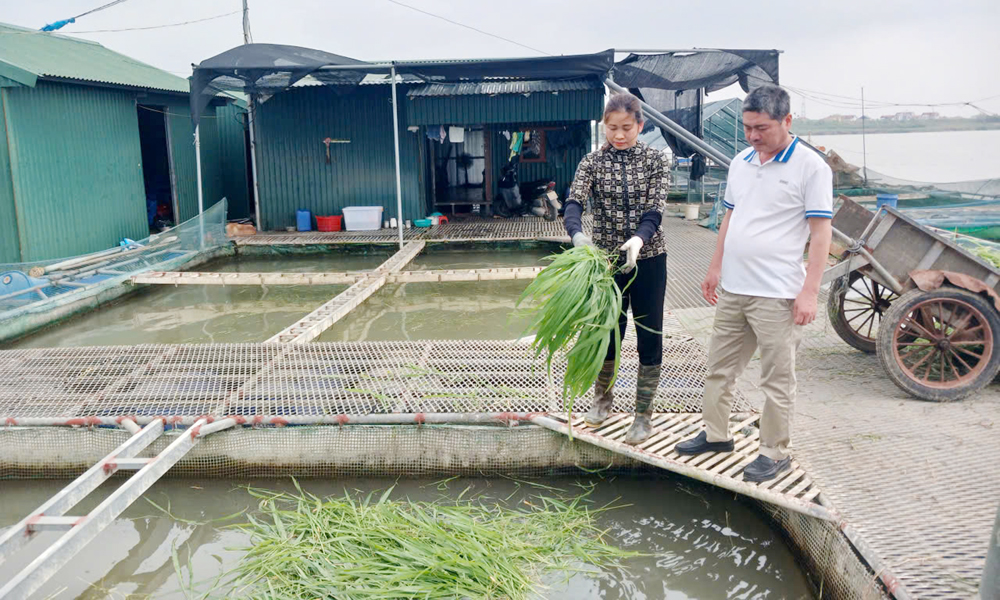
Officials from the provincial Sub-Department of Livestock Production, Animal Health and Fisheries inspect the fish farming model of Nong Thi Thao’s family. |
Do Dang Thuc, a farmer in Mao Dien ward, is among early adopters. In 2016, his family invested nearly 2 billion VND (80,000 USD), including around 650 million VND in provincial support, to install 50 cages for farming sturgeon, red tilapia, black carp and crispy carp on the river.
Each cage is carefully monitored, with detailed records on stocking dates, feed types, quantities and disease prevention measures, allowing full traceability of products when brought to market.
Thanks to the application of VietGAP standards, fish in Thuc’s farm have shown strong growth, low disease incidence and consistent quality, helping secure stable demand. With an annual output of 250–300 tonnes, his farm generates revenue of 10–15 billion VND, yielding net profits of around 1.2–1.5 billion VND per year.
“Cage farming on rivers allows much higher stocking density than traditional pond farming,” Thuc said. “Each cage, with a volume of 160–220 cubic metres, can hold thousands of fish, equivalent to about one hectare of pond area.”
However, he noted that the model requires substantial upfront investment, estimated at 100–150 million VND per cage for fingerlings and feed, along with technical know-how and suitable river conditions, including stable, clean water and sufficient depth.
Similar success has been recorded by Truong Van Viet and his wife Nong Thi Thao in Chi Lang commune, who left industrial jobs in 2018 to invest more than 1 billion VND in cage farming on the Duong River.
With 12 cages raising sturgeon and “bong” fish, the family now produces nearly 40 tonnes annually, earning about 6 billion VND in revenue and roughly 500 million VND in profit each year.
Effective development path
Across Bac Ninh, aquaculture covers about 16,200 hectares, including reservoirs, low-lying fields and small ponds. In the past, production relied largely on traditional pond farming and natural fishing, resulting in modest yields.
Recent years have seen a shift toward river-based cage farming. The province currently has 154 households operating 2,958 cages, with an average productivity of 5–6 tonnes per cage annually. Total output from this model is estimated at 16,000–16,500 tonnes per year, accounting for nearly 20% of the province’s aquaculture production.
According to Nguyen Huu Tho, head of the provincial Sub-Department of Livestock Production, Animal Health and Fisheries, local authorities have introduced support measures, including subsidies of 15 million VND per cage, provision of biological products for water treatment, and planning of designated farming zones to control density.
Efforts have also focused on trade promotion, brand building linked to product traceability, and training farmers in VietGAP-compliant techniques. Pilot models have been developed to assess the performance of different fish species and improve production efficiency.
Advances in breeding, feed and environmental management are now widely applied, while the use of probiotics helps stabilize water quality, improve fish health and reduce pollution. As a result, large-scale disease outbreaks have been largely avoided, and farmed fish products have gained consumer trust.
The species mix has also shifted toward high-value fish such as sturgeon, carp and tilapia, further enhancing economic returns for farmers.
While the model is proving effective, officials caution that expansion must be carefully managed to align with inland waterway regulations and mitigate risks related to disease, environmental impacts and extreme weather.
With its growing contribution to output and farmer incomes, river cage fish farming is increasingly seen as a sustainable development direction for Bac Ninh’s aquaculture sector.


.jpg)


Reader's comments (0)